
Breaking into human resources or advancing within the field often feels like navigating a maze of credentials, certifications, and professional development programs. Unlike fields with clear, universal certification paths—think accounting with CPA or project management with PMP—human resources presents a more fragmented landscape where the “right” credential depends heavily on your location, career stage, and specific HR focus area.
This complexity creates real challenges for HR professionals and aspiring practitioners. Questions arise constantly: Which certifications do employers actually value? Are expensive programs worth the investment? Do credentials earned in one country hold weight elsewhere? How do you choose between competing certification bodies? For those working in technical roles like system administration who want to transition into HR technology or analytics positions, understanding which credentials bridge that gap becomes even more crucial.
The good news is that despite this complexity, certain certifications and educational programs have established strong reputations within specific markets and specializations. Understanding the landscape, knowing what employers seek, and strategically choosing credentials that align with your career goals can significantly strengthen your professional positioning.
Understanding the HR Certification Landscape
Human resources certifications serve multiple purposes beyond simply adding letters after your name. They demonstrate foundational knowledge, signal commitment to the profession, provide structured learning in areas you might not encounter in daily work, and create networking opportunities with other HR professionals. However, not all certifications carry equal weight, and the value of specific credentials varies considerably by geography and industry.
Why HR Certifications Matter
Employers use certifications as screening mechanisms when evaluating candidates, particularly for positions requiring specific knowledge or expertise. In competitive job markets, certifications can differentiate you from other applicants with similar experience levels. They provide external validation of your capabilities beyond what appears on your resume.
For career changers—people moving from other fields into HR or from technical roles into HR technology positions—certifications offer a way to demonstrate HR knowledge and commitment despite lacking traditional HR job titles. This pathway becomes particularly relevant for professionals in technical roles who see opportunities in the growing HR technology and analytics space.
Certifications also structure your professional development. Rather than haphazardly learning about various HR topics, certification programs provide comprehensive curricula covering essential knowledge areas. This systematic approach ensures you understand the full scope of HR practice, not just the areas your current role exposes you to.
Geographic Variations in HR Certification Value
One of the most important factors in choosing HR certifications is understanding geographic variations in their recognition and value. A credential highly valued in North America might be less recognized in Europe or Asia, and vice versa. This geographic specificity creates complications for internationally mobile professionals or those working for multinational organizations.
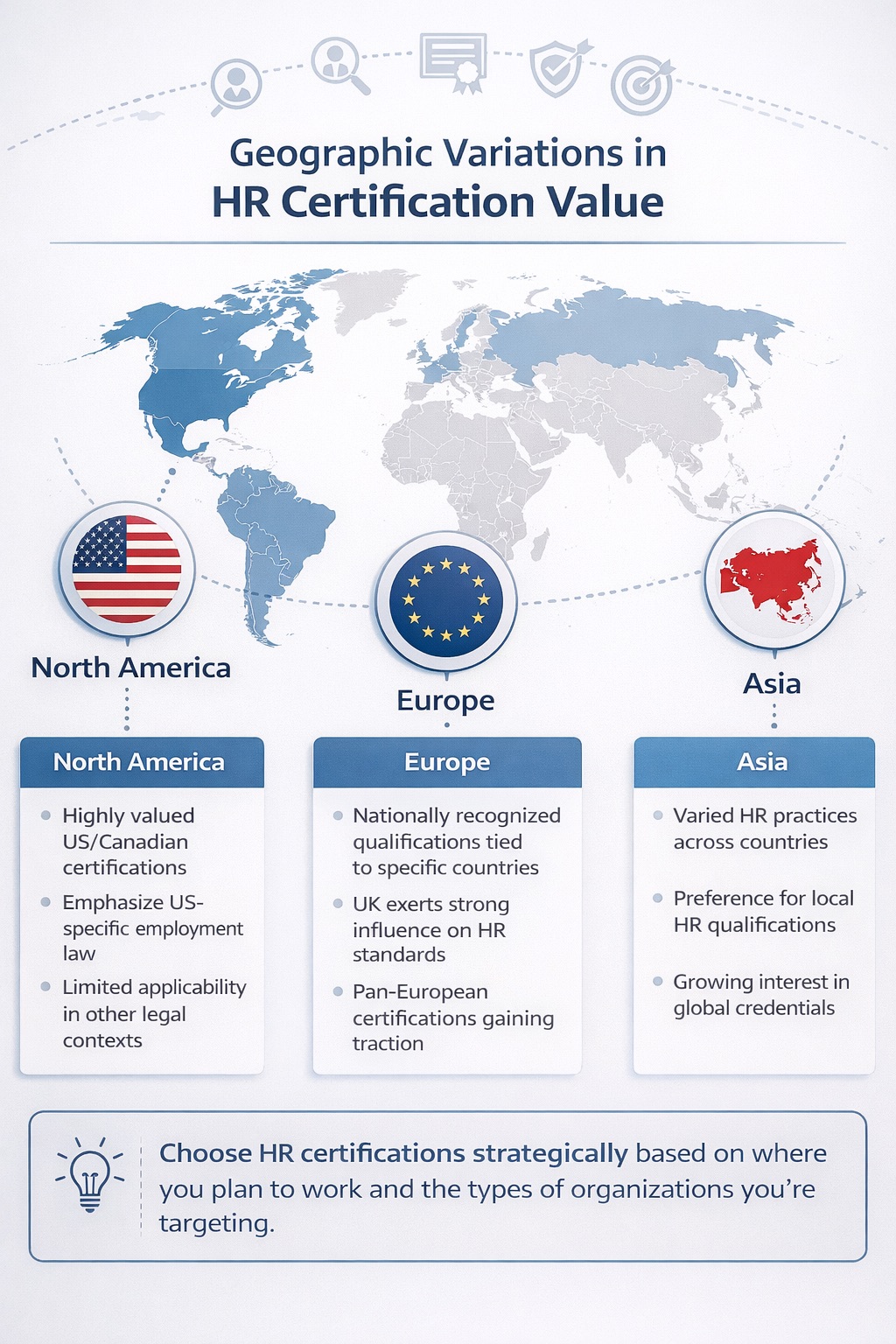
European HR certification structures differ significantly from North American approaches. European countries often favor nationally recognized qualifications tied to specific professional bodies within each country, though some pan-European credentials are gaining traction. The United Kingdom, despite its exit from the European Union, maintains significant influence on European HR standards through established professional bodies.
North American certifications, particularly those from major professional associations, have strong recognition within the United States and Canada but varying acceptance elsewhere. These certifications often emphasize knowledge of U.S. employment law and practices, which limits their direct applicability in other legal contexts while still demonstrating general HR competency.
Understanding these geographic nuances helps you make strategic decisions about which credentials to pursue based on where you plan to work and what types of organizations you’re targeting.
Major HR Certifications in Europe
European HR professionals have access to various certification pathways, with significant variation between countries. However, certain credentials have established strong reputations across multiple European markets.
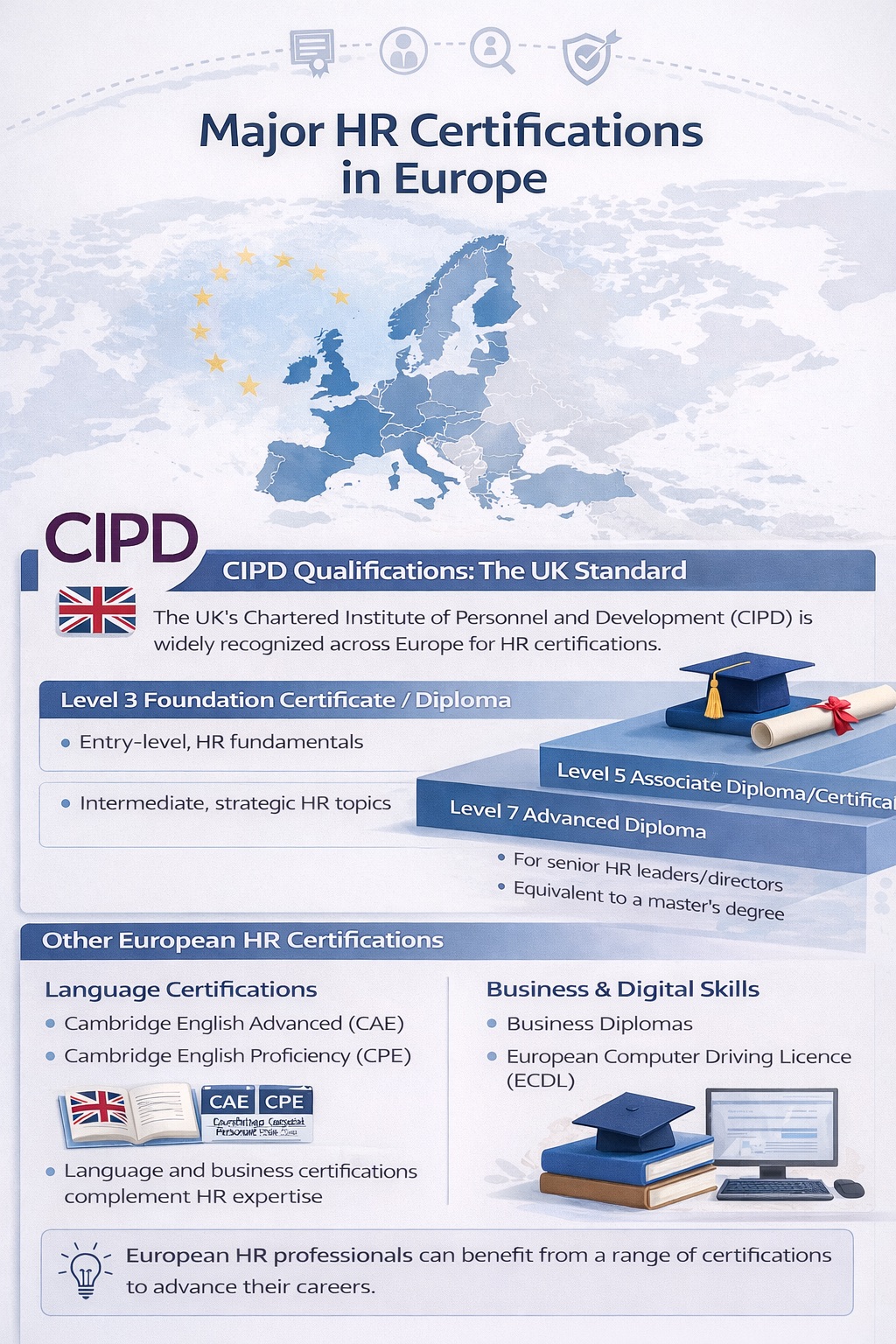
CIPD Qualifications: The UK Standard
The Chartered Institute of Personnel and Development represents the primary professional body for HR practitioners in the United Kingdom and maintains significant recognition across Europe and globally. CIPD qualifications follow a tiered structure corresponding to career stages and responsibility levels.
The CIPD Level 3 Foundation Certificate or Diploma suits individuals at the beginning of their HR careers or those considering transitioning into HR from other fields. This introductory level covers fundamental HR concepts including recruitment basics, employment law fundamentals, employee relations principles, and essential people management skills. The Foundation level doesn’t assume prior HR knowledge, making it accessible for career changers.
Level 3 programs typically require several months of part-time study and include both theoretical learning and practical application. The curriculum provides a broad overview of HR functions, helping learners understand how different aspects of people management interconnect. For someone working in a non-HR role but handling some people-related responsibilities, Level 3 demonstrates foundational competency.
The CIPD Level 5 Associate Diploma or Certificate targets HR advisors, specialists, and managers. This intermediate qualification assumes working knowledge of HR and delves deeper into strategic aspects of people management. Level 5 covers advanced topics including organizational development, talent management, employment law application, evidence-based decision making, and strategic workforce planning.
Level 5 represents a significant step up in rigor and depth from Level 3. The program typically requires extensive case study analysis, research projects, and demonstrated ability to apply HR principles to complex organizational challenges. Many HR professionals pursue Level 5 qualifications while working in HR roles, using their workplace experiences to inform their studies.
The CIPD Level 7 Advanced Diploma sits at the top of the qualification structure, equivalent to a master’s degree in human resources. Designed for senior HR practitioners, directors, and strategic business partners, Level 7 emphasizes strategic thinking, organizational leadership, complex change management, and evidence-based HR practice at the highest levels.
Level 7 programs require substantial commitment—often one to two years of intensive part-time study. The curriculum includes advanced research methodology, strategic organizational development, international HR management, and sophisticated approaches to workforce planning and talent strategy. Completing Level 7 demonstrates capability for senior HR leadership roles.
CIPD qualifications offer significant value beyond the UK. While they’re most recognized in British and Commonwealth contexts, they’re increasingly acknowledged across Europe and globally as indicators of serious HR expertise. Employers in countries outside the UK may not be familiar with CIPD specifically, but the tiered structure and association with a respected professional body generally translates well.
For professionals in European countries without strong national HR certification structures, CIPD qualifications provide internationally recognized credentials. The fact that CIPD programs are available through distance learning makes them accessible regardless of location, though this accessibility comes with relatively high costs compared to some alternatives.
Other European HR Certifications
Beyond CIPD, various European countries maintain their own professional HR bodies and associated certifications. Germany’s DGFP (Deutsche Gesellschaft für Personalführung) offers credentials recognized within German-speaking markets. France’s ANDRH provides professional development and certification for French HR practitioners. These national certifications carry strong weight within their home markets but less recognition internationally.
The European Association for People Management works to create more standardized approaches to HR professional development across Europe, though national certifications remain predominant. For professionals planning to work across multiple European countries, international credentials like CIPD or globally recognized certifications from North American bodies often provide broader recognition than country-specific qualifications.
Language and Business Certifications Supporting HR
HR work, particularly in international contexts, requires strong communication skills and business acumen beyond just HR-specific knowledge. Language certifications and business qualifications complement HR credentials and enhance your professional profile.
Cambridge English certifications, including the Cambridge English Advanced (CAE) and Cambridge English Proficiency (CPE), are widely recognized across Europe and globally for demonstrating English language competency. The CAE certifies advanced English proficiency (C1 level on the Common European Framework of Reference), while CPE certifies mastery-level proficiency (C2 level).
For HR professionals working in international environments or with multinational companies, demonstrated English proficiency is increasingly essential. English serves as the common business language in many European contexts, and HR work often involves interpreting complex policies, drafting sensitive communications, and facilitating discussions requiring nuanced language use.
Business qualifications like Cambridge International A-levels in Business or diplomas in business management provide foundational understanding of business principles, financial basics, and organizational operations. This business literacy helps HR professionals understand the broader business context in which people management decisions occur and communicate more effectively with business leaders.
The European Computer Driving Licence (ECDL), now often called ICDL (International Computer Driving Licence), certifies basic digital literacy and computer skills. While this credential might seem basic for professionals in technical fields, it demonstrates fundamental competency in office software, digital communication, and information management—skills essential for any professional role.
Major HR Certifications in North America
North America, particularly the United States, has established HR certification structures that differ considerably from European approaches. These certifications enjoy strong recognition within North American markets and varying recognition internationally.
SHRM Certifications
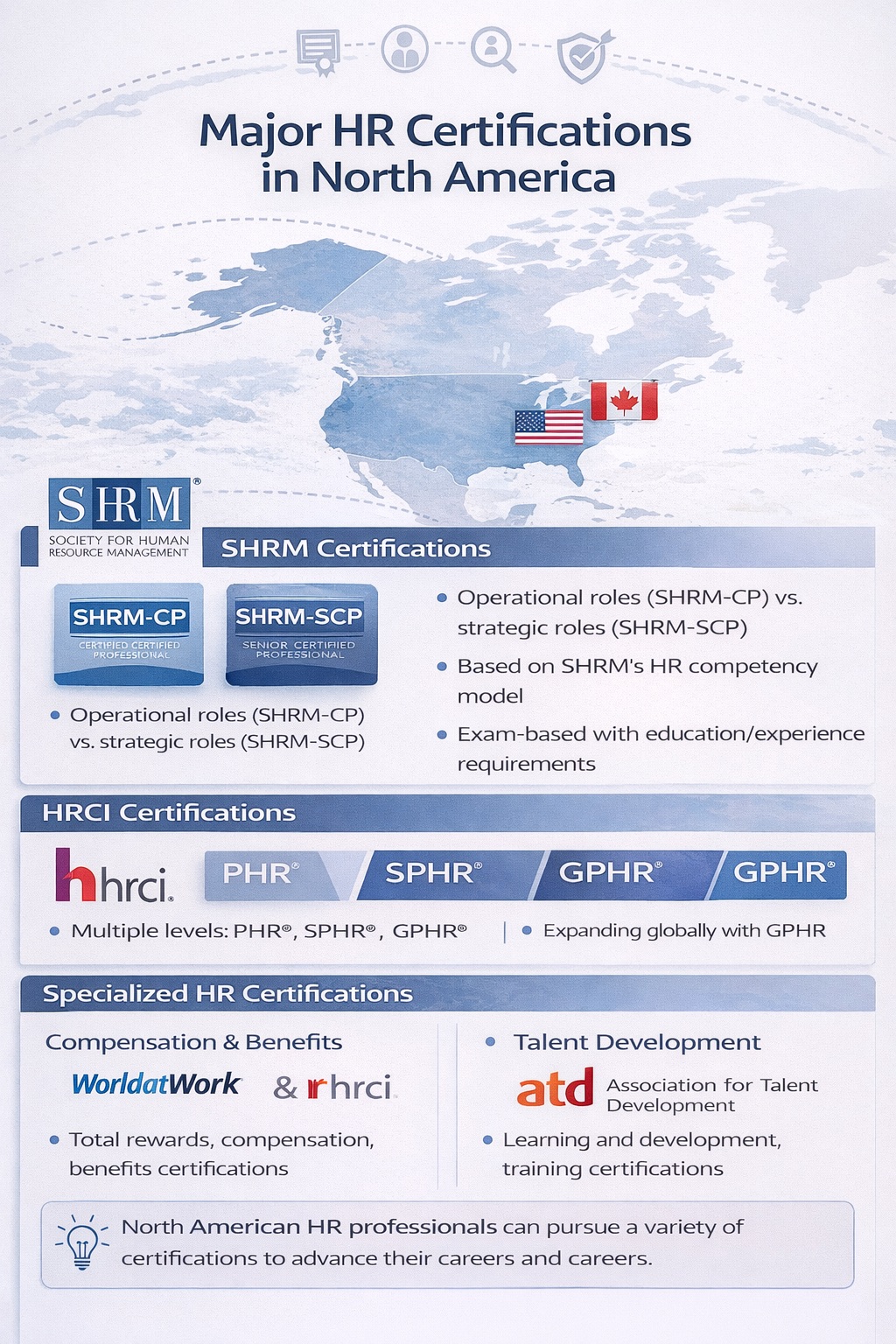
The Society for Human Resource Management, the world’s largest HR professional association, offers two primary certification tracks. The SHRM Certified Professional (SHRM-CP) targets HR professionals in operational or tactical roles, while the SHRM Senior Certified Professional (SHRM-SCP) addresses senior HR professionals in strategic positions.
Both certifications test knowledge across the full spectrum of HR practice based on SHRM’s competency model, which includes behavioral competencies like leadership, communication, and relationship management alongside technical HR knowledge in areas such as talent acquisition, employee engagement, total rewards, and risk management.
SHRM certifications require passing a comprehensive examination, with eligibility based on combinations of education and HR experience. Unlike tiered learning programs like CIPD, SHRM certifications primarily validate existing knowledge through examination rather than providing structured learning, though SHRM offers study materials and preparation courses.
SHRM credentials carry strong weight with U.S. employers and increasingly with Canadian organizations. Their recognition in other global markets varies—some international employers, particularly U.S.-based multinationals operating globally, recognize and value SHRM credentials, while others may be less familiar with them.
HRCI Certifications
HR Certification Institute, which originated from SHRM before becoming independent, offers the longest-established HR certifications in North America. HRCI maintains several certification levels including the Professional in Human Resources (PHR), Senior Professional in Human Resources (SPHR), and Global Professional in Human Resources (GPHR).
Like SHRM certifications, HRCI credentials are examination-based with eligibility requirements combining education and experience. The certifications test knowledge of HR principles, employment law, and HR functional areas with varying depth based on certification level.
HRCI certifications historically emphasized U.S. employment law knowledge, which limited their international applicability. However, HRCI has expanded internationally with region-specific certifications and the GPHR credential specifically addressing global HR practices. Despite this expansion, HRCI credentials remain most recognized in North American contexts.
Specialized North American Certifications
Beyond general HR certifications, various specialized credentials address specific HR functional areas. The WorldatWork organization offers certifications in total rewards, compensation, benefits, and work-life balance. These specialized credentials suit professionals focusing specifically on compensation and benefits rather than general HR practice.
Talent development certifications from organizations like the Association for Talent Development (ATD) address learning and development, training design, and organizational development specializations. For HR professionals specializing in employee development and training, these credentials provide focused expertise beyond general HR qualifications.
Global and International HR Certifications
As business becomes increasingly global and HR professionals more internationally mobile, certifications with explicit international focus have emerged.
Global Professional in Human Resources (GPHR)
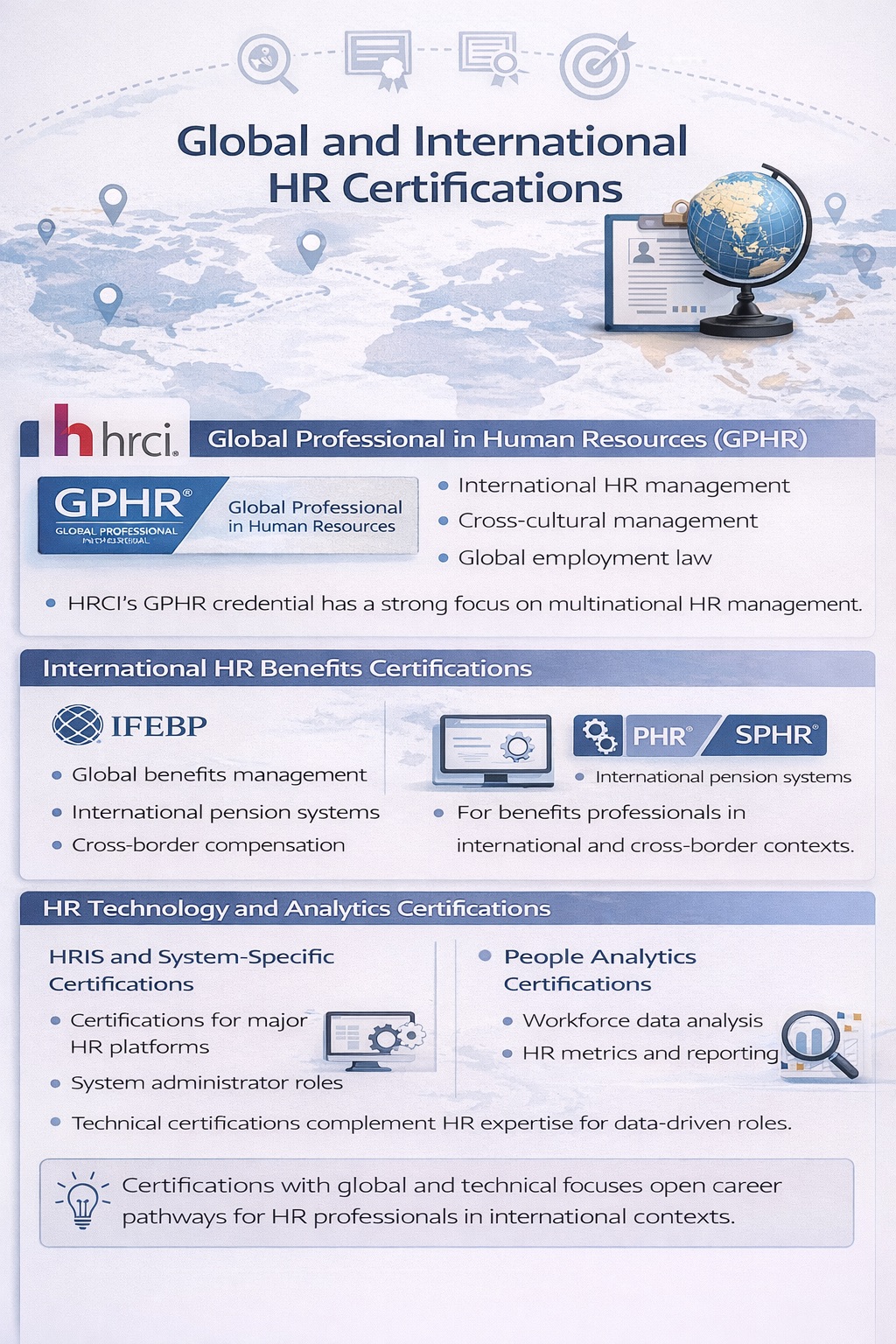
The GPHR certification from HRCI specifically addresses global HR management, covering international assignment management, global talent acquisition, cross-cultural management, international employment law frameworks, and global compensation and benefits. This certification suits HR professionals working for multinational organizations or managing global workforce populations.
The GPHR requires understanding HR practices across multiple countries and legal systems, making it more internationally relevant than certifications focused on single-country contexts. However, it still originates from a U.S.-based organization, which shapes its perspective and primary recognition.
International Foundation of Employee Benefit Plans
For professionals specializing in benefits and compensation in international contexts, the International Foundation offers certifications addressing global benefits management, international pension systems, and cross-border compensation issues. These highly specialized credentials suit professionals in specific functional areas rather than general HR practitioners.
HR Technology and Analytics Certifications
The intersection of HR and technology represents one of the fastest-growing areas in the field. As organizations increasingly rely on HR information systems, analytics platforms, and automation tools, professionals with both HR knowledge and technical capabilities become highly valuable.
HRIS and System-Specific Certifications
Major HRIS platforms offer their own certifications validating expertise in implementing, configuring, and managing their systems. These vendor-specific credentials include certifications for major enterprise platforms and various specialized HR technology solutions.
For professionals already working in technical roles, particularly system administrators, these technology-specific certifications combined with HR knowledge create powerful career opportunities. The combination of understanding both the technical aspects of systems and the HR processes they support makes someone uniquely valuable.
System administrator roles increasingly require HR domain knowledge to configure systems effectively, generate meaningful reports, and support business users. Conversely, HR professionals with technical skills can advance into HR technology specialist, HRIS manager, or HR systems analyst roles. At Decision Makers Hub, we’ve observed that this HR-technology intersection creates significant career opportunities for professionals willing to develop both skill sets.
People Analytics Certifications
As data-driven decision making becomes central to HR practice, certifications in people analytics and HR metrics have emerged. Various universities and professional organizations offer programs teaching workforce analytics, HR metrics and measurement, predictive analytics for HR, and data visualization for people data.
These programs vary from short courses providing basic analytics literacy to comprehensive programs requiring statistical knowledge and programming skills. The appropriate level depends on whether you need basic understanding to consume and interpret analytics or deep expertise to conduct sophisticated analyses independently.
For technically-minded professionals, people analytics represents a natural entry point into HR. The analytical skills developed in technical roles translate well to workforce analytics, while HR domain knowledge can be learned through combination of certifications and practical experience.
How to Choose the Right HR Certification
With so many options, selecting appropriate certifications requires strategic thinking about your career goals, current position, and target markets.
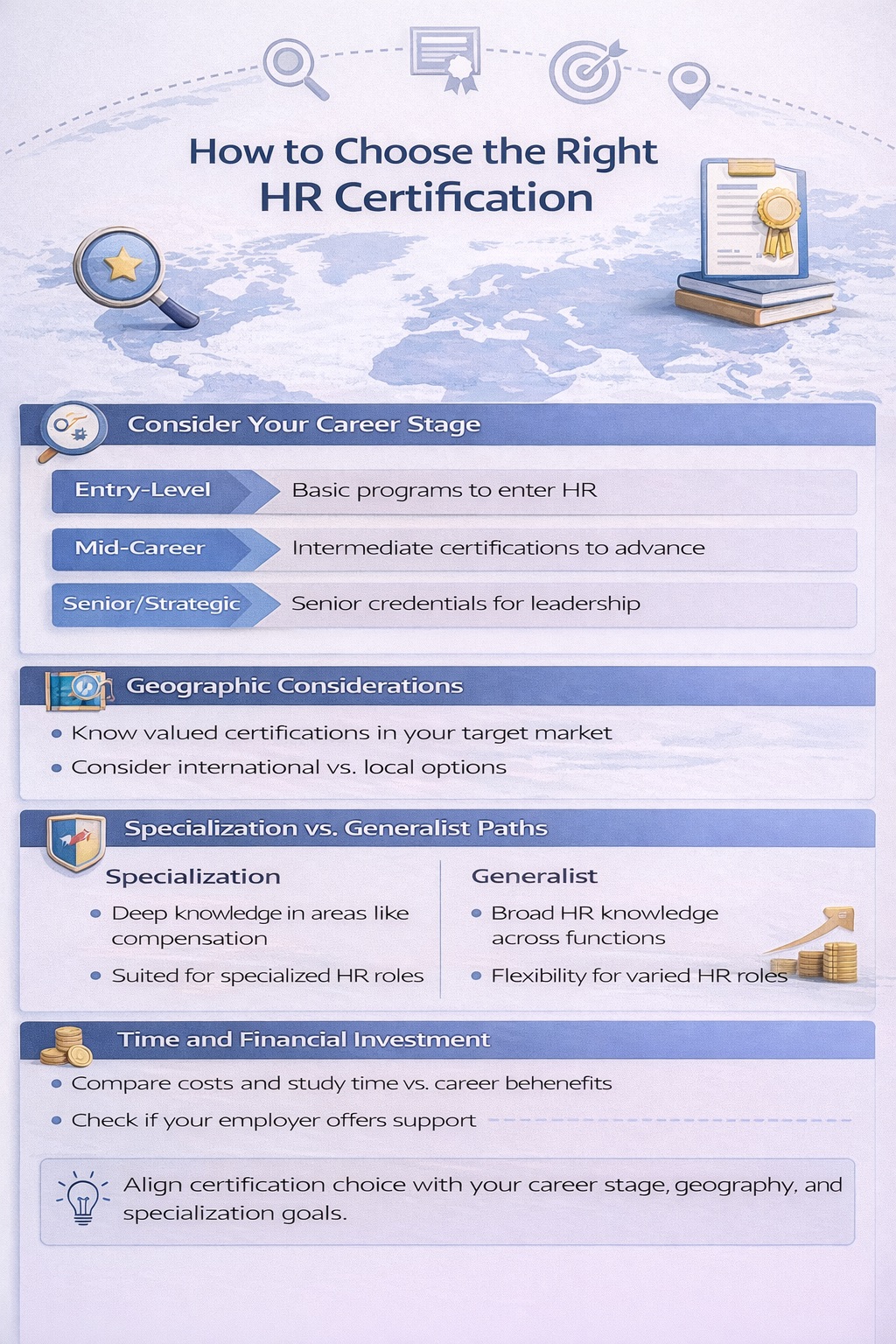
Consider Your Career Stage and Goals
Your career stage significantly influences which certifications make sense. Entry-level certifications provide foundational knowledge if you’re new to HR or transitioning from another field. These introductory programs don’t assume prior HR knowledge and cover broad fundamentals.
Mid-career professionals benefit from intermediate certifications that deepen expertise and demonstrate advancement beyond entry-level knowledge. These programs often assume working HR experience and focus on more complex applications of HR principles.
Senior professionals and those targeting strategic roles should consider advanced certifications demonstrating strategic thinking and leadership capability. These high-level credentials signal readiness for senior HR leadership positions.
Geographic Considerations
Where you plan to work dramatically affects which certifications carry weight. Research what credentials employers in your target market recognize and value. Job postings often mention preferred or required certifications, providing insight into market expectations.
For internationally mobile professionals or those working with multinational organizations, credentials with broad international recognition offer more flexibility than country-specific qualifications. However, if you plan to work primarily in a specific country or region, locally recognized certifications might provide better value than international credentials less familiar in that market.
Specialization Versus Generalist Paths
Decide whether you’re pursuing generalist HR career paths or specializing in specific functional areas. Generalist certifications provide broad HR knowledge applicable across various HR roles and industries. These credentials suit people wanting flexibility to work in different HR functions or smaller organizations where HR professionals handle diverse responsibilities.
Specialized certifications focus deeply on specific areas like compensation, benefits, talent development, or HR technology. These credentials suit professionals committed to particular functional specializations or working in large organizations with specialized HR roles. Specialization can command higher compensation and create strong expertise, though it potentially limits role flexibility.
Time and Financial Investment
Certifications vary enormously in required time and financial investment. Some credentials require years of part-time study and substantial tuition fees. Others involve shorter preparation periods and more modest costs, primarily for examination fees and study materials.
Honestly assess how much time you can realistically dedicate to certification study while managing work and personal responsibilities. Programs requiring intensive study don’t suit everyone, regardless of their potential career value. A less rigorous credential you actually complete provides more value than an advanced certification you start but never finish.
Consider financial investment relative to expected career returns. Expensive certifications make sense when they enable significant career advancement or salary increases. If a credential costs thousands but helps you secure a promotion worth tens of thousands in additional lifetime earnings, that’s a sound investment. Conversely, expensive certifications that don’t substantially improve your employment prospects or earning potential may not justify their cost.
Employer Support and Preferences
Many employers support professional development through tuition reimbursement, study time allowances, or direct payment for certifications. Understanding your employer’s policies can significantly affect which certifications are financially feasible.
Additionally, your current or target employers may have preferences for specific certifications. Organizations sometimes require or strongly prefer particular credentials for advancement into certain roles. Understanding these preferences helps you pursue certifications with clear career payoff within your organization.
Alternative Paths: Online Courses and Professional Development
Not all valuable professional development comes through formal certification programs. Various alternatives provide HR knowledge and skills without requiring traditional certification commitments.
University Certificate Programs
Many universities offer professional certificate programs in HR, often available online or through part-time evening classes. These programs typically require less commitment than full degree programs but more structure than individual courses. University certificates carry academic credibility and often provide similar content to entry or intermediate professional certifications.
These programs suit professionals who value academic rigor but can’t commit to full degree programs. They’re often more affordable than professional certifications while still providing structured learning and recognized credentials.
Online Learning Platforms
Platforms offering online courses provide access to thousands of HR-related courses covering virtually any topic. These platforms offer tremendous flexibility—you can learn specific skills exactly when you need them without committing to comprehensive certification programs.
The limitation of standalone online courses is that they don’t provide widely recognized credentials. Completing a course gives you knowledge and sometimes a certificate of completion, but these course completion certificates don’t carry the professional recognition of established certifications. However, for building specific skills or exploring areas before committing to formal certifications, online courses provide valuable, low-risk options.
Professional Association Memberships
Joining professional HR associations provides access to resources, networking, and professional development without necessarily requiring certification. Organizations like SHRM, CIPD, local HR chapters, and industry-specific HR groups offer conferences, webinars, publications, and networking opportunities that support professional growth.
Professional association memberships signal engagement with the HR community and commitment to staying current in the field. They provide opportunities to learn from experienced practitioners, understand emerging trends, and build professional networks that support career advancement. For many HR professionals, association involvement provides as much or more career value as formal certifications.
Vendor Training and Workshops
HR technology vendors, consulting firms, and specialized training organizations offer workshops and courses on specific HR topics, tools, or methodologies. These programs provide targeted learning on particular skills or systems.
While vendor training rarely results in broadly recognized credentials, it builds specific capabilities valuable in your work. Learning to effectively use particular software, implement specific HR methodologies, or apply certain analytical techniques creates immediate practical value even without formal certification.
Building a Strategic Professional Development Plan
Rather than randomly pursuing certifications or courses as opportunities arise, strategic professional development planning maximizes the return on your time and financial investment.
Assess Your Current Skills and Knowledge Gaps
Start by honestly evaluating your current capabilities and identifying gaps between where you are and where you want to be. This assessment might reveal specific functional knowledge you lack, technical skills that would enhance your effectiveness, or strategic competencies needed for advancement.
This gap analysis provides focus for professional development efforts. Rather than pursuing certifications because they seem prestigious or because colleagues recommended them, you’re targeting credentials that address specific development needs aligned with your career goals.
Set Clear Career Objectives
Professional development serves career advancement, so clarity about your career objectives is essential. Are you trying to transition into HR from another field? Advance from operational to strategic HR roles? Specialize in particular HR functions? Move into HR technology or analytics? Lead global HR functions?
Different career objectives suggest different certification and development paths. A career changer might prioritize foundational certifications establishing HR credibility. Someone seeking advancement into senior strategic roles might focus on advanced certifications and leadership development. A technical professional moving into HR systems work might combine HRIS certifications with HR fundamentals.
Create a Multi-Year Development Timeline
Professional development works best as an ongoing process rather than a one-time event. Creating a multi-year timeline for certifications, courses, and other development activities helps you build capabilities systematically while managing the time and financial commitments involved.
This timeline might include an immediate focus on foundational certifications, followed by specialized credentials after gaining work experience in particular areas, and eventually advanced certifications supporting movement into senior roles. Spreading development activities over time makes them more manageable while ensuring continuous professional growth.
Balance Breadth and Depth
Effective professional development balances broad generalist knowledge with deeper expertise in specific areas. Early career focus on breadth—understanding all major HR functional areas—provides flexibility and context. As your career progresses, developing deeper expertise in areas aligned with your interests and career goals creates differentiation and advancement opportunities.
This might mean pursuing generalist certifications initially, then adding specialized credentials as your career direction becomes clearer. Alternatively, it might involve combining broad HR certifications with deep technical expertise in HR systems or analytics, creating valuable hybrid capabilities.
Leverage Multiple Development Approaches
Don’t rely exclusively on formal certifications. Combine certifications with practical experience, online courses addressing specific skills, professional association involvement, mentorship relationships, and self-directed learning. This varied approach builds robust capabilities more effectively than any single development method.
Certifications provide structure, recognition, and comprehensive knowledge. Practical experience develops application skills and contextual understanding. Targeted courses fill specific skill gaps. Professional associations offer networking and perspective. Mentors provide guidance and wisdom. Self-directed learning enables continuous growth between formal programs.
The Role of Advanced Degrees in HR
Academic degrees in HR or related fields represent alternatives or complements to professional certifications, with different value propositions and tradeoffs.
Bachelor’s Degrees in HR
Undergraduate degrees in human resources, human resource management, or industrial relations provide comprehensive HR education combined with broader university education. These programs typically cover all major HR functional areas along with supporting coursework in business, psychology, law, and statistics.
Bachelor’s degrees serve as entry points to HR careers, particularly for people pursuing HR directly rather than transitioning from other fields. They provide broader education than certifications and are generally preferred by larger employers and for certain HR roles, particularly in competitive markets.
However, bachelor’s degrees require significant time and financial investment—typically four years of full-time study or longer part-time. For professionals already working who want to enter or advance in HR, this investment often isn’t practical. Certifications provide faster, more focused alternatives, though they don’t fully replace degree credentials for certain positions or employers.
Master’s Degrees in HR
Master’s degrees in human resources, industrial relations, or organizational development represent advanced academic credentials that can significantly enhance career prospects, particularly for strategic and senior HR roles. These programs provide deep theoretical understanding, research capabilities, and strategic perspectives beyond what professional certifications typically offer.
Top master’s programs, particularly from well-regarded universities, carry substantial prestige and can open doors to competitive positions with leading employers. They provide networking opportunities with cohorts of ambitious HR professionals and access to faculty expertise and research.
The tradeoffs involve substantial time commitments—typically one to two years full-time or two to three years part-time—and often significant costs, particularly for programs from prestigious universities. Return on investment depends heavily on career goals and whether the credential enables advancement or opportunities that justify the investment.
For senior HR professionals, executive education programs or specialized master’s degrees completed while working provide advanced learning without requiring career breaks. These part-time or modular programs recognize that mid-career professionals bring substantial experience to their studies, creating learning environments enriched by participants’ practical insights.
MBA with HR Concentration
Master of Business Administration programs with HR concentrations or specializations provide broader business education combined with HR focus. These programs suit professionals who want general business leadership credentials with HR expertise or who might pursue career paths spanning HR and other business functions.
MBAs from top programs carry significant prestige and provide networking opportunities extending beyond HR into broader business leadership. They signal strategic business thinking and general management capability, not just HR specialization.
The tradeoff is that MBAs provide less HR-specific depth than dedicated HR master’s programs. The curriculum focuses substantially on finance, marketing, operations, and strategy with HR as one concentration among many. For professionals committed to HR careers, dedicated HR programs often provide more relevant, deeper expertise.
Maximizing the Value of Your Certifications
Earning certifications represents just the first step. Maximizing their career value requires effectively leveraging them in your professional positioning and development.
Update Your Professional Profiles
Immediately update your resume, LinkedIn profile, and other professional materials to reflect new certifications. Include the credential in your name if appropriate, list it in dedicated certifications sections, and mention it in professional summaries highlighting your qualifications.
Professional certifications signal commitment and expertise to recruiters and hiring managers reviewing profiles and applications. Making these credentials visible ensures they contribute to your professional positioning.
Maintain and Renew Certifications
Most professional certifications require periodic renewal through continuing education, re-examination, or professional activity. Understanding renewal requirements and planning to meet them ensures your credentials remain current and valuable.
Allowing certifications to lapse wastes the initial investment and removes credentials from your professional profile. Building continuing education and renewal into your professional development planning maintains your credentials while ensuring you stay current in your field.
Apply Your Learning
The knowledge gained through certification programs only creates value when applied in practice. Actively look for opportunities to use new concepts, frameworks, and skills in your work. This application reinforces learning, demonstrates value to employers, and builds practical competency beyond theoretical knowledge.
Certification programs often introduce concepts and approaches you wouldn’t encounter in your daily work. Proactively seeking opportunities to pilot new approaches or apply learned concepts expands your practical capabilities and potentially improves organizational outcomes.
Build on Foundation Certifications
Foundation and entry-level certifications provide starting points for professional development, not endpoints. Plan how you’ll build on initial certifications through advanced credentials, specialized knowledge, or complementary qualifications.
This progressive approach demonstrates ongoing commitment to professional development and builds increasingly sophisticated expertise. It also keeps you engaged with evolving practices and emerging trends in HR.
Common Mistakes to Avoid
Understanding common pitfalls in pursuing HR certifications helps you make more effective decisions and avoid wasting time and resources.
Pursuing Certifications Without Clear Purpose
Collecting certifications without clear career objectives rarely produces good outcomes. Each credential should serve specific career purposes—filling knowledge gaps, meeting employer requirements, enabling specialization, or signaling advancement readiness.
Before committing to any certification program, clearly articulate why you’re pursuing it and what career outcomes you expect. If you can’t identify clear purposes beyond general resume enhancement, reconsider whether the investment makes sense.
Overvaluing Credentials Relative to Experience
Certifications complement experience but don’t replace it. Some professionals, particularly early career or career changers, accumulate multiple certifications hoping credentials will compensate for limited practical experience. This rarely works as intended.
Employers value the combination of knowledge (demonstrated through education and certifications) and capability (demonstrated through experience). Certifications without supporting experience may signal theoretical knowledge without practical competency. Balance credential pursuit with gaining relevant work experience, even if that means taking lateral moves or temporary positions to build HR experience.
Choosing Certifications Based Solely on Prestige
The most prestigious or well-known certifications aren’t necessarily the best choices for your specific circumstances. A highly regarded certification that emphasizes content irrelevant to your career goals or isn’t recognized in your target market provides limited value despite its general prestige.
Choose certifications strategically based on alignment with your career objectives and recognition by employers you’re targeting, not just general reputation or what colleagues recommend without considering your specific situation.
Neglecting Soft Skills Development
HR fundamentally involves working with people, requiring strong soft skills including communication, influence, empathy, conflict resolution, and political acumen. Technical HR knowledge matters, but interpersonal effectiveness often determines success in HR roles.
While pursuing certifications to build technical knowledge, don’t neglect developing soft skills through practice, feedback, coaching, and deliberate skill-building. The most successful HR professionals combine solid technical knowledge with exceptional people skills.
Failing to Research Market Recognition
Not all credentials carry equal weight in all markets. Before investing in certifications, research what employers in your target geography and industry actually value. Job postings often mention preferred certifications. Speaking with recruiters, HR professionals in your network, and hiring managers provides insight into which credentials influence hiring decisions.
Pursuing certifications unknown or unrecognized in your market wastes resources that could be invested in credentials employers actually value.
The Future of HR Certifications
The HR certification landscape continues evolving in response to changing work environments, emerging HR practices, and shifting skill requirements.
Growing Emphasis on Analytics and Technology
HR certifications increasingly incorporate analytics, data literacy, and technology competencies reflecting these capabilities’ growing importance in HR practice. Future certifications will likely require demonstrated ability to work with HR data, interpret analytics, and leverage technology effectively.
This trend creates opportunities for technically-minded professionals entering HR or expanding into HR technology roles. Certifications explicitly addressing HR analytics and technology will likely proliferate, while traditional certifications will incorporate more technology and data content.
Modular and Stackable Credentials
Rather than comprehensive certifications requiring extensive time commitments, modular approaches allowing professionals to earn credentials for specific competencies or knowledge areas are emerging. These stackable credentials let professionals build qualifications incrementally, focusing on immediately relevant capabilities while working toward more comprehensive certifications over time.
This flexibility suits working professionals who can’t commit to intensive programs but want to continuously develop capabilities relevant to their roles and career progression.
Digital Badges and Micro-Credentials
Beyond traditional certifications, digital badges recognizing specific skills or achievements are proliferating. These micro-credentials provide granular validation of capabilities and can be shared easily on professional profiles and social media.
While micro-credentials don’t replace comprehensive certifications, they complement them by recognizing specific competencies and creating motivation for continuous learning through frequent, incremental accomplishments.
International Harmonization
As workforces become more global and professionals more mobile, pressure for internationally recognized credentials increases. Professional bodies are exploring mutual recognition agreements, harmonized competency standards, and international qualification frameworks.
This trend toward harmonization will likely make HR qualifications more portable across borders, benefiting internationally mobile professionals and organizations operating across multiple countries.
Taking Action: Your Next Steps
Understanding the HR certification landscape is valuable only when it translates into concrete professional development action. Here are practical next steps for moving forward.
Clarify Your Career Direction
Before pursuing any certifications, invest time in clarifying your career objectives. Where do you want to be professionally in three to five years? What roles interest you? What type of organization do you want to work for? What aspects of HR work energize you?
This clarity provides direction for professional development investments, ensuring they serve specific career purposes rather than representing unfocused resume building.
Research Relevant Certifications
Based on your career objectives and target market, research certifications that align with your goals. Look at job postings for positions you aspire to, noting which certifications they mention. Speak with people working in roles you’re targeting, asking about credentials that helped their careers. Consult with recruiters about what they see employers valuing.
This research ensures you invest in credentials that will actually advance your specific career rather than pursuing generally prestigious certifications without clear relevance to your goals.
Create a Development Plan
Develop a concrete professional development plan spanning the next two to three years. Identify which certifications you’ll pursue and when, considering sequencing, time requirements, and costs. Include other development activities—courses, conferences, association involvement—creating a comprehensive growth plan.
Having a written plan increases follow-through and helps you allocate time and resources appropriately. It also provides a framework for tracking progress and adjusting as your career evolves.
Start with Manageable Commitments
If you’re new to professional certifications, start with manageable commitments rather than immediately pursuing the most advanced, intensive programs. Successfully completing an introductory certification builds confidence, clarifies whether certification study suits your learning style, and creates momentum for additional development.
You can always pursue more advanced credentials later. Starting with achievable commitments ensures you actually complete certifications rather than starting ambitious programs you abandon due to overwhelming time demands.
Invest in Your Professional Development
Recognize that professional development represents investment in your career with potential returns far exceeding the initial costs in time and money. While certifications require real sacrifices—study time taken from other activities, tuition and examination fees—they create opportunities for advancement, increased compensation, and career satisfaction that justify the investment.
Treating professional development as discretionary spending you’ll get to when convenient virtually guarantees you won’t prioritize it. Viewing it as essential investment in your career future creates the commitment necessary for consistent follow-through.
The HR certification landscape may seem complex and overwhelming initially, but strategic navigation of it enhances your career significantly. By understanding the major certifications relevant to your market, choosing credentials aligned with your career goals, and systematically building capabilities over time, you create professional positioning that opens doors and enables career advancement.
Whether you’re just entering HR, looking to advance within the field, or bringing technical capabilities into HR technology and analytics roles, appropriate certifications combined with practical experience and continuous learning create the foundation for successful, satisfying HR careers.