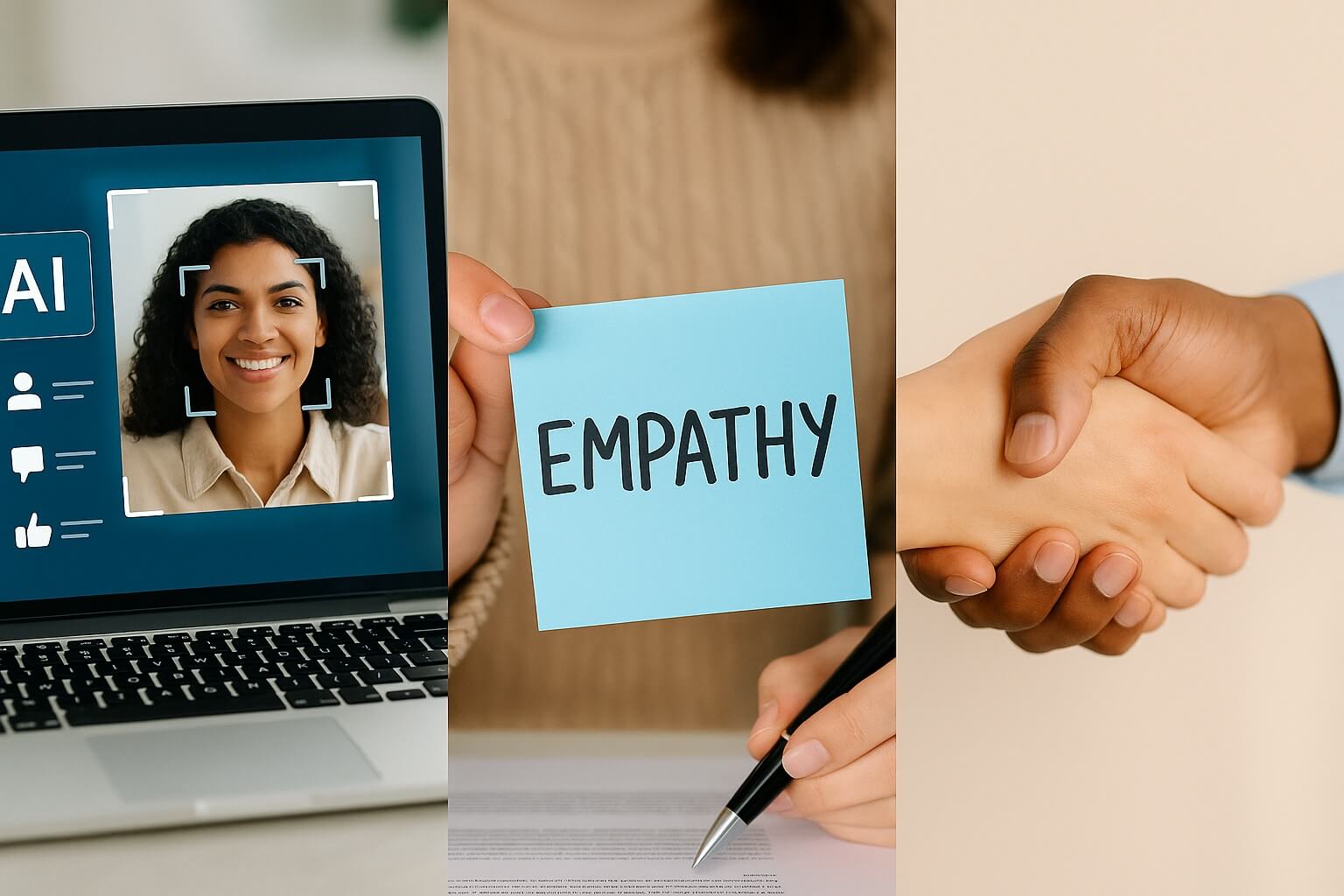
The numbers are brutal: 85% of job success comes from well-developed soft skills, yet 89% of bad hires happen because recruiters failed to assess them properly (LinkedIn Global Talent Trends, 2025). Meanwhile, the average time-to-hire has ballooned to 44 days, and candidate ghosting is at an all-time high.
Enter AI-powered real-time assessment tools.
These systems no longer just scan résumés for keywords. They watch, listen, probe, and score the very human traits that predict on-the-job performance: communication, empathy, adaptability, critical thinking, resilience, collaboration, leadership, emotional intelligence, and consistency under pressure.
Here are the nine most powerful ways modern AI is revolutionizing soft-skills detection, backed by real data and real-world deployment examples.
1. Conversational Scenario Simulations (The New Behavioral Interview)
Instead of asking “Tell me about a time you dealt with a difficult coworker,” AI presents live, branching scenarios:
“You’re leading a project. Your top performer just missed a critical deadline because of a family emergency. The client is furious and threatening to pull the contract. What do you do right now, and what do you say to each stakeholder?”
The candidate responds in natural language (voice or chat). The AI follows up in real time with deepening probes, objections, or new complications. Within 12–18 minutes it produces a scored profile across 8–12 soft-skill dimensions.
Real-world impact: A Fortune-500 logistics firm using CloudApper AI integrated with UKG reduced bad hires linked to poor conflict-management skills by 41% in one year.
2. Micro-Expression & Facial Coding Analysis
Top-tier video interview platforms now run lightweight facial-action-coding engines (trained on millions of labeled expressions) that detect fleeting emotions: contempt, fear, genuine enthusiasm, discomfort, or cognitive load.
Example metrics captured in <0.3 seconds:
- Asymmetry in a smile (indicator of forced vs. authentic positivity)
- Rapid eyebrow raises (surprise or stress)
- Lip compression (suppressed frustration)
Combined with voice stress patterns, these signals predict traits like emotional stability and resilience with 78–84% accuracy (2025 meta-study, Journal of Applied Psychology).
3. Linguistic Pattern Recognition (Beyond Sentiment)
Natural-Language Understanding models dissect word choice, sentence complexity, hedging language, ownership pronouns (“I” vs. “we”), and concreteness.
Red flags the AI catches instantly:
- Excessive use of passive voice when describing past achievements → low accountability
- Overuse of absolutes (“always,” “never”) → rigidity, low adaptability
- High ratio of negative emotion words when discussing former employers → low resilience
A 2025 LinkedIn + Workday study found linguistic audit of 1.2 million interviews showed candidates who scored in the top 10% for ownership language were 3.1× more likely to receive a promotion within 18 months.
4. Cognitive Reflection & Decision-Making Under Pressure
AI can present time-boxed ethical dilemmas or resource-allocation puzzles and measure not just the final answer, but the reasoning path.
Example prompt used by multiple Big-Four consulting firms: “You have $100,000 left in the annual training budget and three urgent requests totaling $180,000. Rank them and explain trade-offs in 4 minutes or less.”
The system scores speed vs. quality, logical coherence, stakeholder consideration, and creativity. High performers typically pause 15–20 seconds to think before speaking, low performers rush or ramble.
5. Voice Analytics: The Hidden Soft-Skills Goldmine
Modern voice engines extract 200+ acoustic features per second:
- Pitch variance, speaking rate, pauses, filler words, warmth, assertiveness, vocal fry, upward inflection.
A 2024 MIT-Harvard study proved that candidates whose vocal warmth score was in the top quartile were rated 2.7× higher on empathy and team fit by actual hiring managers, even when transcripts were identical.
6. Consistency Scoring Across Multiple Touchpoints
The smartest systems no longer evaluate a single interview in isolation. They compare responses across:
- Initial AI chat screening
- Video interview
- Written take-home exercise
- Reference check sentiment (when available)
Sudden shifts in tone, values, or claimed achievements, or humility level trigger automatic consistency flags. In one documented case, a VP-level candidate was rejected after the AI detected 11 major inconsistencies between his LinkedIn profile, résumé, and live responses, inconsistencies human recruiters had missed entirely.
7. Adaptive Difficulty & Stress Testing
Just like a video game, the best AI interviewers increase difficulty when a candidate performs well, and they deliberately introduce friction to test grace under pressure.
Common stress injections:
- Polite interruptions
- Skeptical follow-ups (“I’m not sure I believe that would actually work…”)
- Role-playing an angry customer or micromanaging boss
Candidates who maintain composure, active listening, and solution focus despite provocation score dramatically higher on emotional regulation and leadership potential.
8. Collaboration & Team Dynamics Simulation
Some platforms now drop candidates into multiplayer text or voice simulations with AI “teammates” who exhibit specific personalities (e.g., dominant, passive-aggressive, highly analytical).
The system tracks turn-taking, credit-sharing language, consensus-building moves, and inclusive pronouns. Google and Amazon have quietly rolled out versions of this for leadership-track hires, reporting 60% better prediction of actual team performance than traditional assessment centers.
9. Bias-Mitigated Scoring with Explainability Layers
The newest generation of tools doesn’t just give a score; it shows exactly why:
“Adaptability score: 91/100 Evidence: Candidate pivoted strategy three times in response to new constraints without frustration language and maintained 94% vocal stability.”
This transparency satisfies EEOC/UK GDPR requirements and lets recruiters defend decisions with data instead of gut feel.
The Bottom-Line Impact (Documented 2025 Results)
Organizations using comprehensive AI soft-skills detection report:
- 34–47% reduction in 12-month attrition (Deloitte)
- 28% faster time-to-hire due to fewer interview rounds (Gartner)
- 72% higher consistency in evaluation scores across recruiters (SHRM)
- Significant reduction in unconscious bias for gender, ethnicity, and age when raw scores are used blindly
How to Get These Capabilities Today
You don’t need a custom-built solution. Platforms like CloudApper AI Recruiter, HireVue Genesis, and Modern Hire now offer out-of-the-box conversational AI that:
- Integrates directly with UKG Pro, UKG Ready, and 40+ other ATS/HRIS systems
- Delivers scenario-based assessments in 20+ languages
- Provides real-time soft-skills scoring with full audit trails
- Requires zero coding to launch
Forward-thinking TA teams are already replacing phone screens and first-round interviews entirely with 15–20 minute AI conversations that are more predictive, more candidate-friendly (89% report preferring AI over human phone screens when done well), and dramatically faster, and far less biased.
The Future Is Already Here
By 2027, Gartner predicts 75% of all enterprise interviewing volume will include an AI-powered soft-skills component. The only question left for talent acquisition leaders is whether you’ll be an early mover who gains a measurable hiring advantage, or whether you’ll wait until every competitor has already raised the bar.
Soft skills were always the hardest part of hiring. AI just made them the easiest to measure accurately, fairly, and at scale.
Ready to see real-time, scenario-based soft-skills detection in action inside your UKG environment? → Explore CloudApper Conversational AI for UKG Recruiting.