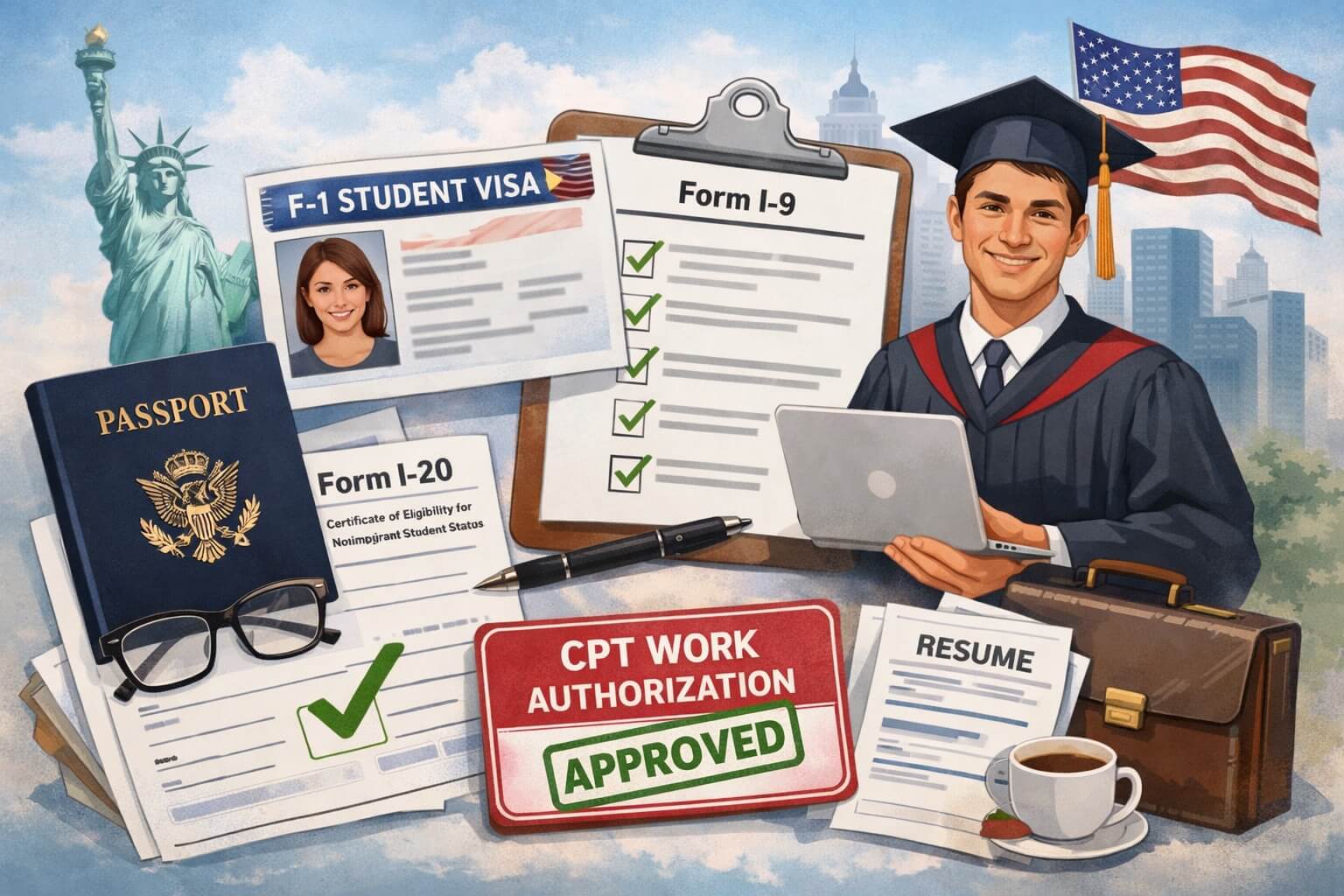
Starting an internship or job on Curricular Practical Training (CPT) is an exciting step for international students. But when it’s time to complete your I-9 employment verification paperwork, many F-1 students find themselves confused about which documents they need—especially if their passport is unavailable.
If you’ve sent your foreign passport for renewal and haven’t received it back yet, or if you’re facing any other passport-related delay, you might be wondering whether you can still complete your I-9 verification on time. The good news is that you have options. Let’s break down everything you need to know about I-9 verification for F-1 students on CPT.
What Is Form I-9 and Why Do You Need It?
Form I-9, officially called the Employment Eligibility Verification form, is a mandatory document that every employer in the United States must complete for every new hire. This includes employers hiring F-1 students for internships, on-campus jobs, or CPT positions.
The purpose of Form I-9 is simple: it verifies two things about you as an employee. First, it confirms your identity—that you are who you say you are. Second, it establishes that you’re legally authorized to work in the United States.
As an F-1 student, your work authorization comes from your student status and specific permission documented on your Form I-20. Understanding how this works is crucial for completing your I-9 correctly.
The I-9 Three-Day Rule: What You Need to Know
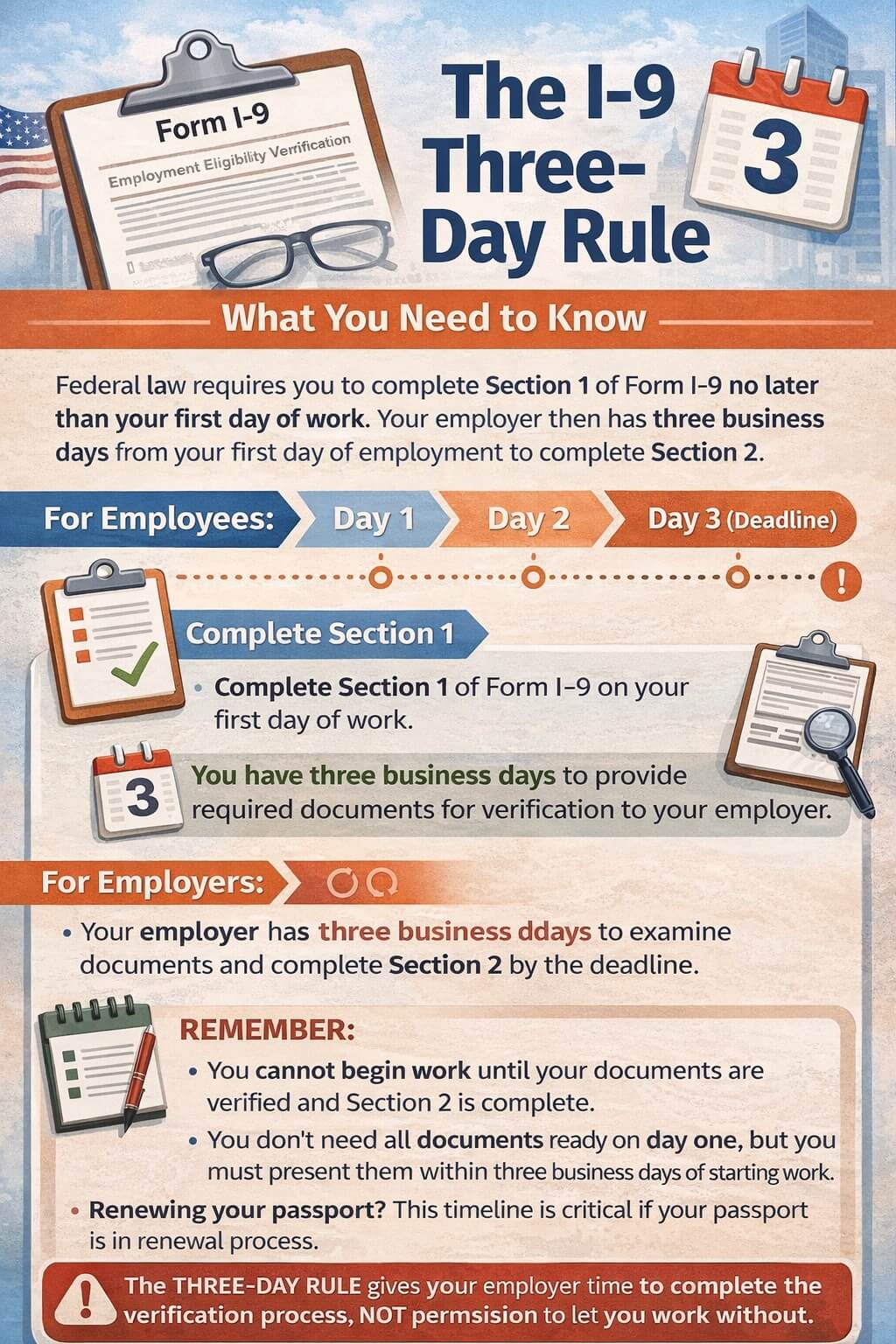
Federal law requires that you complete Section 1 of Form I-9 no later than your first day of work. Your employer then has three business days from your first day of employment to complete Section 2, which involves examining your documents and verifying your information.
This three-day window is important. It means you don’t need to have all your documents ready on day one, but you do need them within three business days after you start working. If your passport is in the renewal process, this timeline becomes critical to understand.
However, it’s important to note that you cannot begin working at all until your employer has verified your documents and completed Section 2. The three-day rule gives your employer time to complete the verification process, not permission for you to work without proper documentation.
Understanding I-9 Document Lists
Form I-9 accepts documents from three different lists, and understanding these lists is key to knowing your options:
List A Documents: These documents establish both your identity and your employment authorization at the same time. If you present a List A document, you don’t need anything else.
List B Documents: These documents establish your identity only. If you use a List B document, you must also present a List C document.
List C Documents: These documents establish your employment authorization only. They must be paired with a List B document.
For F-1 students on CPT, the situation is unique because your employment authorization comes from a combination of documents rather than a single card or permit.
Can You Complete I-9 Without Your Passport?
Yes, in most cases, F-1 students on CPT can complete their I-9 verification without presenting a passport. Under official USCIS guidelines, students participating in CPT may choose to present either List A documents or a combination of List B and List C documents.
Here’s how it works:
Option 1: The Standard CPT Document Set (List A)
The most common way for CPT students to verify employment eligibility is by presenting three documents together: an unexpired foreign passport, Form I-94 showing F-1 status, and Form I-20 with DSO endorsement for CPT. These three documents together count as one List A document.
If your passport is unavailable, this option won’t work for you right now.
Option 2: Alternative Document Combination (List B + List C)
This is where your other documents come into play. F-1 students on CPT can instead present a List B document for identity verification combined with List C documents for employment authorization.
For List B (Identity): Your U.S. state driver’s license qualifies as a List B document. It establishes your identity through your photo and personal information.
For List C (Employment Authorization): You can present your Form I-94 indicating F-1 nonimmigrant status together with your properly endorsed Form I-20. These documents together establish your authorization to work through CPT.
So to answer the common question directly: Yes, you can complete I-9 verification using your driver’s license (List B) plus your I-94 and endorsed I-20 (List C) without needing your passport.
What Makes a Form I-20 “Properly Endorsed” for CPT?
Your Form I-20 must have specific CPT authorization information to be acceptable for I-9 purposes. Here’s what needs to be on there:
CPT Authorization Section: Page 2 of your I-20 should have a section specifically for employment authorization. This section must be completed and signed by your Designated School Official (DSO).
Employment Details: The endorsed section should include your employer’s name, the location of employment, the type of CPT (part-time or full-time), and the start and end dates of your authorization.
DSO Signature and Date: Your school’s DSO must have signed and dated the CPT authorization. Without this signature, your I-20 doesn’t prove work authorization.
If you haven’t gotten CPT authorization added to your I-20 yet, you need to contact your international student office immediately. You cannot begin work without this authorization, regardless of which documents you present for I-9.
Understanding Your Form I-94
Your Form I-94, or Arrival/Departure Record, is an important document that shows when you entered the United States and what visa status you hold.
Electronic I-94: Since 2013, most international arrivals receive electronic I-94 records rather than paper forms. You can retrieve your I-94 online at the official CBP website by entering your passport information and travel details.
What It Should Show: Your I-94 should indicate “F-1” as your nonimmigrant status. It typically shows “D/S” (duration of status) rather than a specific end date, meaning your status is valid as long as you maintain your student status.
Printout Acceptance: Employers can accept a printout of your electronic I-94 for I-9 purposes. You don’t need an original paper I-94 if you entered the U.S. after the system became electronic.
Step-by-Step: Completing Your I-9 Without a Passport
Here’s exactly what you need to do:
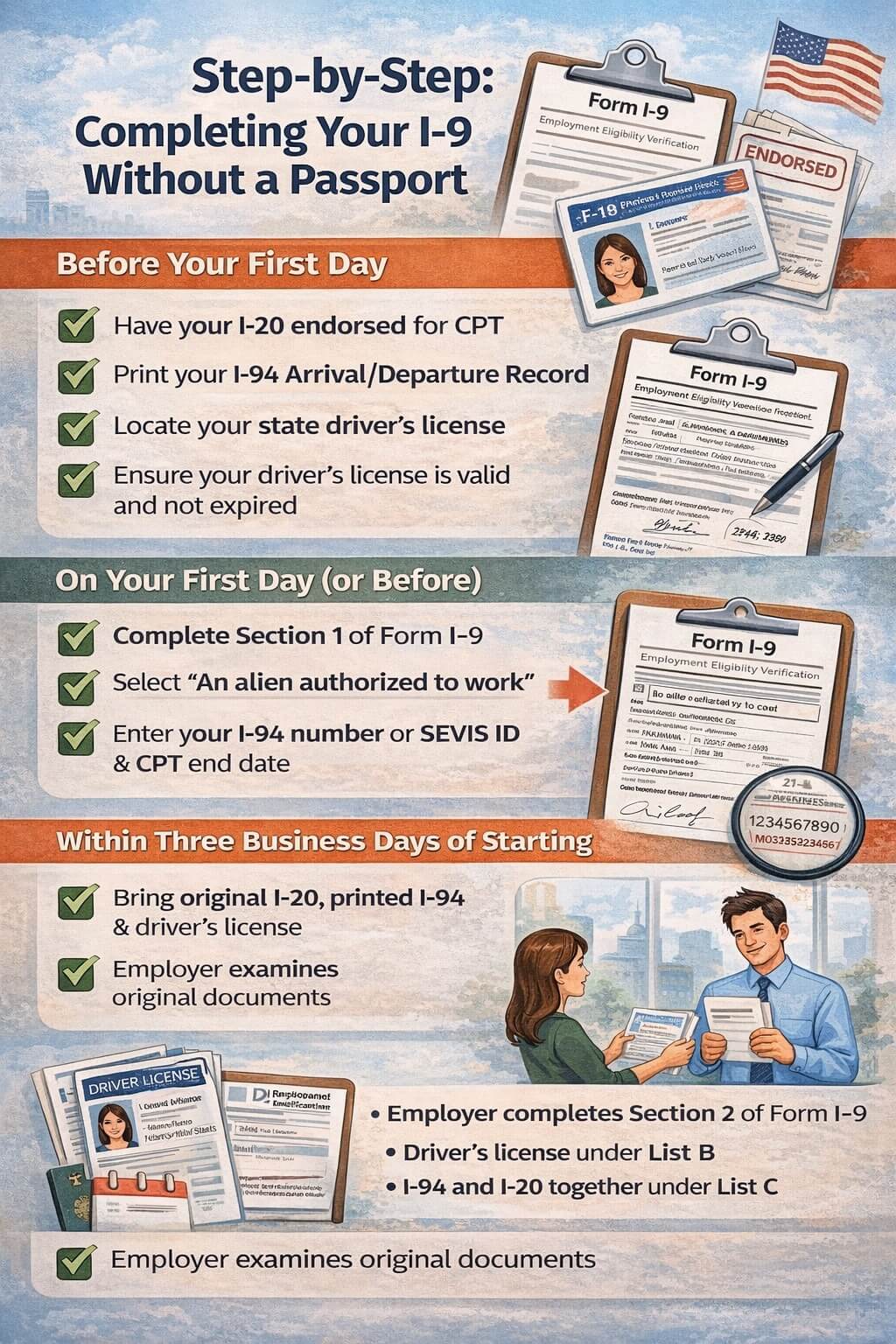
Before Your First Day
- Contact your international student office and ensure your I-20 has been properly endorsed for CPT
- Download and print your I-94 from the CBP website
- Locate your state driver’s license
- Make sure your driver’s license is not expired
On Your First Day (or Before)
- Complete Section 1 of Form I-9
- In the “citizenship/immigration status” section, select “An alien authorized to work”
- In the field asking “if applicable, Alien Registration Number/USCIS Number OR Form I-94 Admission Number,” enter your SEVIS ID number (found on your I-20) or your I-94 admission number
- Enter the date your work authorization expires (use the CPT end date from your I-20)
- Sign and date Section 1
Within Three Business Days of Starting
- Bring your original documents to your employer: state driver’s license, I-94 printout, and endorsed I-20
- Allow your employer to examine the original documents (they cannot accept copies)
- Your employer will complete Section 2 while looking at your original documents
- Your employer should list your driver’s license under List B and your I-94 plus I-20 under List C
Common Concerns and Questions
What if my passport arrives after I complete I-9?
Once your I-9 is properly completed with your driver’s license, I-94, and I-20, you don’t need to redo it when your passport arrives. The form is complete and valid as is.
Can I use an expired driver’s license?
No. All documents presented for I-9 verification must be unexpired. If your driver’s license has expired, you’ll need to renew it before using it for I-9 purposes.
What if my employer insists they need my passport?
Employers cannot require specific documents for I-9 verification. This is actually prohibited under anti-discrimination laws. You have the legal right to choose which acceptable documents to present, as long as they meet the List A or List B + List C requirements. If your employer insists on seeing only a passport, you can direct them to the USCIS guidance on acceptable documents.
Does my Social Security card count as a List C document?
Social Security cards are List C documents for U.S. citizens and permanent residents, but they don’t establish work authorization for F-1 students on CPT. Your work authorization comes specifically from your F-1 status and CPT approval, which is documented on your I-94 and endorsed I-20.
Can I use a receipt for my passport application?
No. The I-9 receipt rule applies only to receipts for replacement of lost, stolen, or damaged documents, not for documents that are being renewed or issued for the first time. A receipt for your passport renewal doesn’t count as an acceptable document for I-9 purposes.
Special Situations for F-1 Students
On-Campus Employment
If you’re working on campus rather than off-campus with CPT, the document requirements are slightly different. For on-campus employment, F-1 students can present just an unexpired foreign passport and I-94 indicating F-1 status, without needing the I-20 to show specific employment authorization. However, you can still use the List B + List C option (driver’s license plus I-94 and I-20) if your passport is unavailable.
Optional Practical Training (OPT)
If you’re working on OPT rather than CPT, the situation is different. OPT students receive an Employment Authorization Document (EAD) card from USCIS. This EAD serves as a standalone List A document showing both identity and work authorization. You would present your EAD card for I-9 verification rather than the document combinations discussed here.
STEM OPT Extension
Students on STEM OPT extensions have special considerations. Your EAD will be marked “STU: STEM OPT ONLY” and your employer must be enrolled in E-Verify. Even with a STEM extension, the I-9 process follows the same basic rules, but reverification becomes important when your authorization periods end.
What Employers Need to Know
If you’re an HR professional or employer hiring F-1 students on CPT, here are key points to remember:
Accept Alternative Documents: Students have the right to present either List A documents or List B + List C combinations. You cannot require them to present a passport if they have other acceptable documents.
Record Information Correctly: When a CPT student presents a driver’s license with I-94 and I-20, you should list the driver’s license information under List B and both the I-94 and I-20 information under List C.
Use the Correct End Date: For CPT students, the work authorization end date should be the CPT end date shown on the I-20, not the program end date or I-94 date.
Understand Combination Documents: The foreign passport, Form I-94, and Form I-20 presented together count as one List A document. Similarly, when I-94 and I-20 are presented as List C documents, they work together to establish employment authorization.
Don’t Discriminate: Requiring specific documents or refusing to accept valid alternative documents violates federal anti-discrimination laws. All employees must be allowed to choose which acceptable documents to present.
Planning Ahead: Best Practices for F-1 Students
To avoid last-minute stress with I-9 verification, follow these best practices:
Keep Documents Current: Always maintain an unexpired driver’s license or state ID. Renew these well before they expire.
Get CPT Authorization Early: Don’t wait until the last minute to get your I-20 endorsed for CPT. Start the process several weeks before your intended start date.
Know Where Your Documents Are: Keep your I-20, I-94 printout, and driver’s license in a safe, accessible place. You’ll need to present originals to your employer.
Plan Passport Renewals Carefully: If you need to renew your passport, time it during periods when you won’t need it for employment verification. Many countries’ passport renewals take 4-8 weeks or longer.
Communicate with Your Employer: If you know your passport will be unavailable, let your employer know in advance that you’ll be using alternative documents. This prevents confusion during the onboarding process.
Understanding Your Rights
As an F-1 student completing Form I-9, you have specific rights protected by federal law:
Right to Choose Documents: You can decide which acceptable documents to present. Employers cannot demand specific documents.
Protection from Discrimination: Employers cannot treat you differently than other employees in the I-9 process based on your citizenship status or national origin.
Right to Work: Once properly authorized through CPT and with valid I-9 documentation, you have the legal right to work for your approved employer during your approved period.
Privacy Protection: Your employer must keep your I-9 form confidential and separate from other personnel files.
If you believe your employer has discriminated against you in the I-9 process, you can file a complaint with the U.S. Department of Justice’s Immigrant and Employee Rights Section.
Reverification: What Happens When CPT Ends
When your CPT authorization expires, your employer must reverify your employment authorization if you continue working. This happens in Section 3 of Form I-9 (or Supplement B on newer forms).
For F-1 students, reverification is triggered by whichever document has the earlier end date between your I-94 and I-20. Typically, your CPT end date on the I-20 will come first.
At reverification time, you can present any List A or List C document showing continued work authorization. This might be a new I-20 with extended CPT dates, an OPT EAD card, or evidence of a change to a different work-authorized status like H-1B.
Emergency Situations and Timing Issues
What if you’re cutting it close on the three-day deadline?
Be Honest with Your Employer: If you’re having trouble getting your documents together, communicate openly with your HR department. They may be able to work with you on timing.
Understand the Firm Deadline: While employers have flexibility in when they complete Section 2, you absolutely cannot work without proper I-9 verification. If the three-day window expires without completed verification, you must stop working until it’s resolved.
Expedite What You Can: If your I-20 endorsement is delayed, follow up persistently with your international student office. For I-94 issues, the CBP Deferred Inspection office may be able to help.
Know When to Seek Help: If you’re facing a situation where you truly cannot obtain the necessary documents in time, consult with your international student advisor or an immigration attorney.
Resources for Additional Help
If you need more information or assistance:
Your School’s International Student Office: This is always your first stop for questions about your I-20, CPT authorization, or F-1 status issues.
USCIS I-9 Central: The official USCIS website has comprehensive resources about Form I-9, including the M-274 Handbook for Employers with detailed guidance.
CBP I-94 Website: You can retrieve your electronic I-94 at the official U.S. Customs and Border Protection website.
Your Employer’s HR Department: They should be trained on proper I-9 procedures and can answer questions about their specific processes.
Immigration Attorney: For complex situations or if you’re facing discrimination, consider consulting with an immigration attorney who specializes in student visa issues.
The Bottom Line
As an F-1 student starting CPT employment, you have multiple options for completing your I-9 verification. While having your passport makes the process straightforward, it’s not absolutely required. With your state driver’s license, I-94, and properly endorsed I-20, you can complete the I-9 process successfully.
The key is understanding which documents establish identity versus employment authorization, and knowing that you have the right to choose which acceptable document combination to present. Don’t let passport renewal delays prevent you from starting your internship or CPT position on time.
Make sure your I-20 is properly endorsed for CPT before your start date, keep your driver’s license current, and have your I-94 readily available. With these documents in order, you can complete your employment verification smoothly and start your work experience with confidence.
Remember, the I-9 process exists to verify that you’re authorized to work—and as an F-1 student with approved CPT, you absolutely are authorized. The documents just need to prove it, and you have multiple ways to do that successfully.