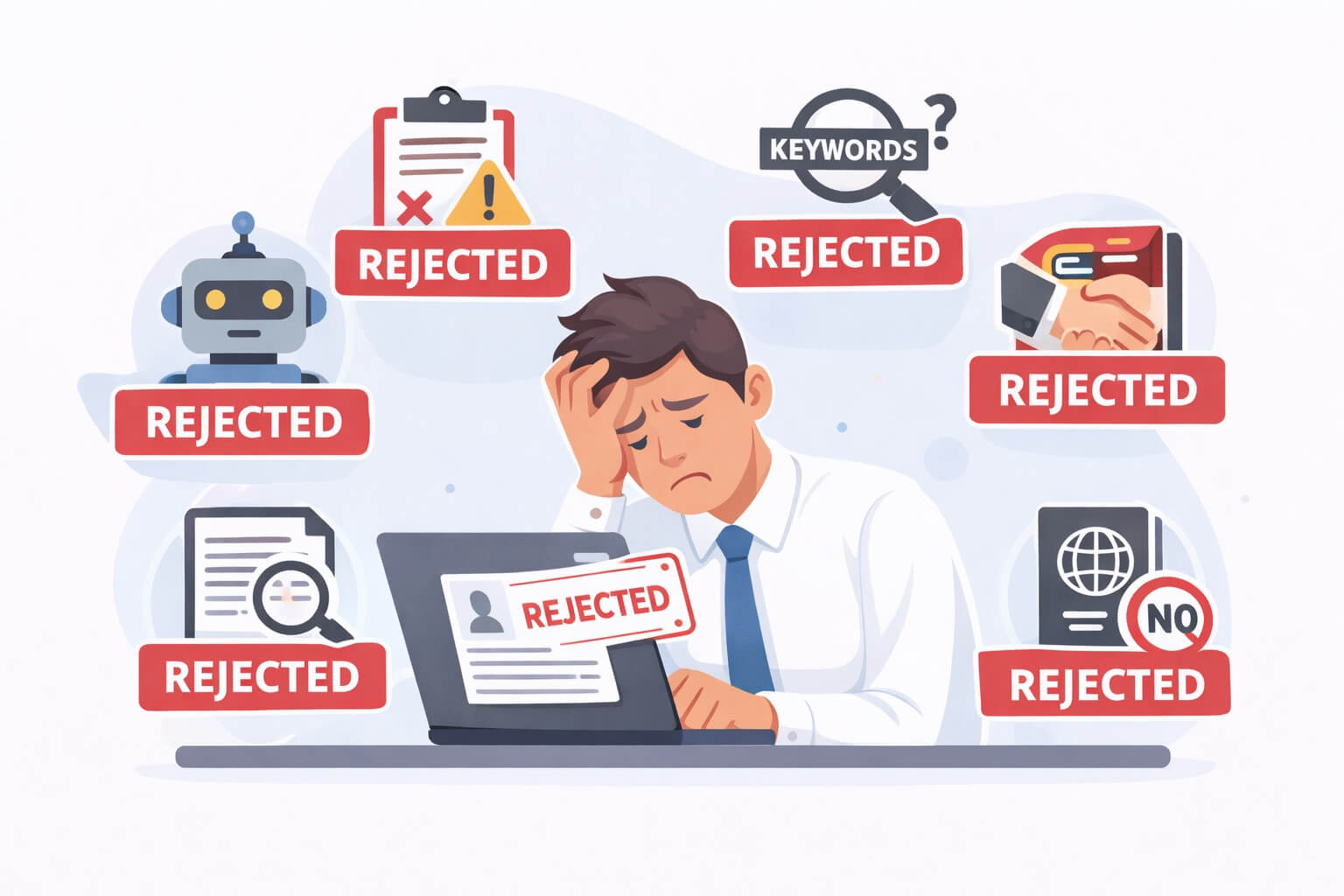
Getting rejected from job after job can feel soul-crushing, especially when those rejections come within hours—sometimes even minutes—of submitting your application. You’ve sent out hundreds of applications, tailored your resume countless times, and even secured internal referrals, yet nothing seems to work. The automated rejection emails keep piling up, and you’re left wondering: “Am I doing something wrong, or am I somehow blacklisted?”
If this sounds familiar, you’re not alone. Thousands of job seekers across the United States and Canada face the same frustrating mystery every day. The good news is that these instant rejections usually have identifiable causes, and once you understand what’s happening, you can take concrete steps to fix the problem.
What Are Auto-Rejections and How Do They Work?
Auto-rejections happen when applicant tracking systems (ATS) or automated screening tools filter out candidates before any human ever sees their application. These systems scan resumes for specific criteria and immediately reject applications that don’t meet certain thresholds.
Most medium to large companies use ATS software to manage the flood of applications they receive. When a company posts a job and receives 200-500 applications, hiring managers simply can’t review every single resume manually. The ATS acts as the first gatekeeper, sorting applications into “qualified” and “not qualified” piles based on predetermined rules.
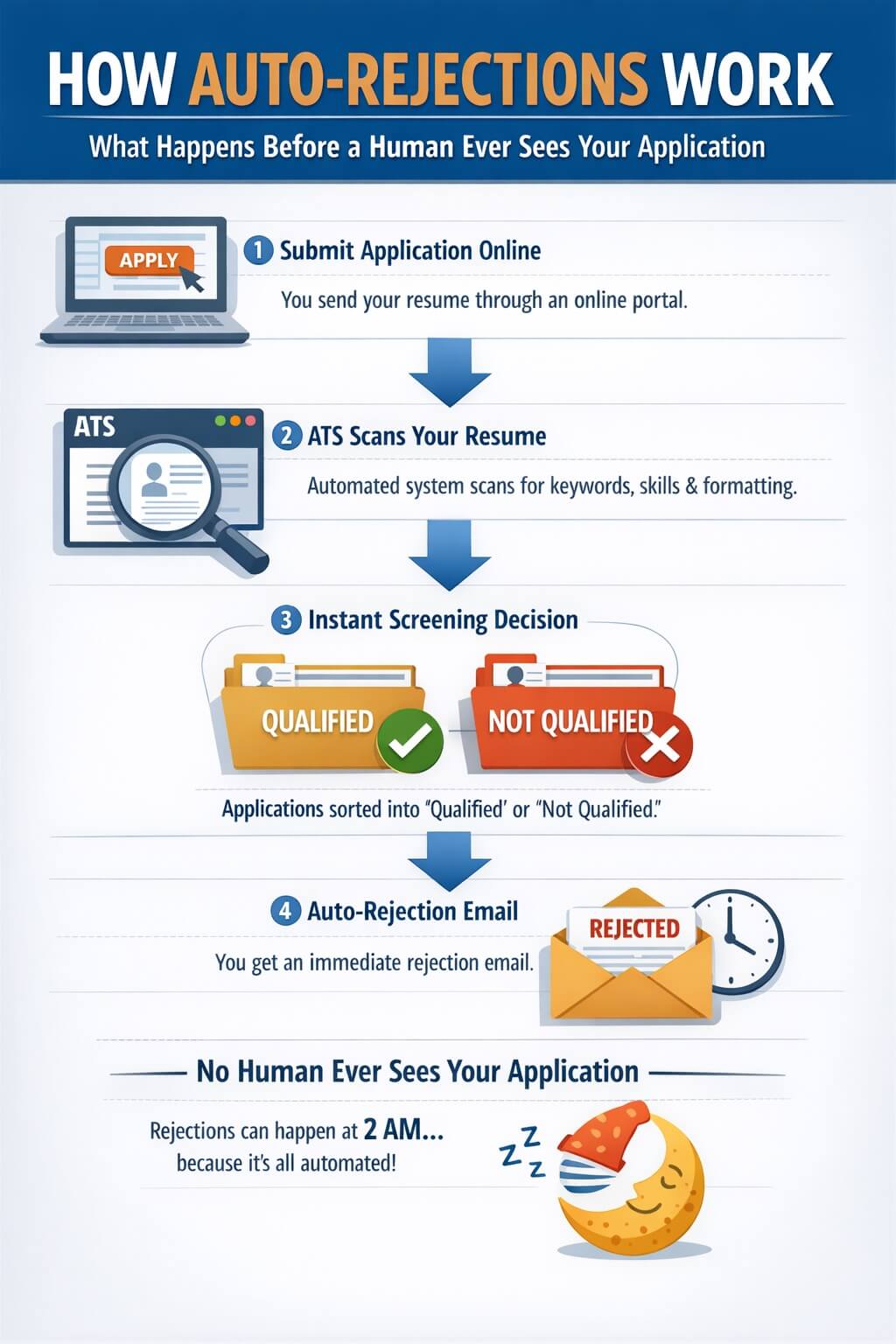
The rejection process typically works like this: You submit your application through an online portal. The ATS immediately scans your resume for keywords, qualifications, and formatting. Within seconds to minutes, the system makes a decision. If you don’t pass the automated screening, you receive an instant or near-instant rejection email. A human hiring manager never sees your application.
This explains why you can receive rejection emails at 2 AM on a Sunday—there’s no human involved in that initial decision.
Common Reasons for Instant Rejections
Understanding why ATS systems reject candidates is the first step toward fixing the problem. Here are the most common reasons for immediate rejections.
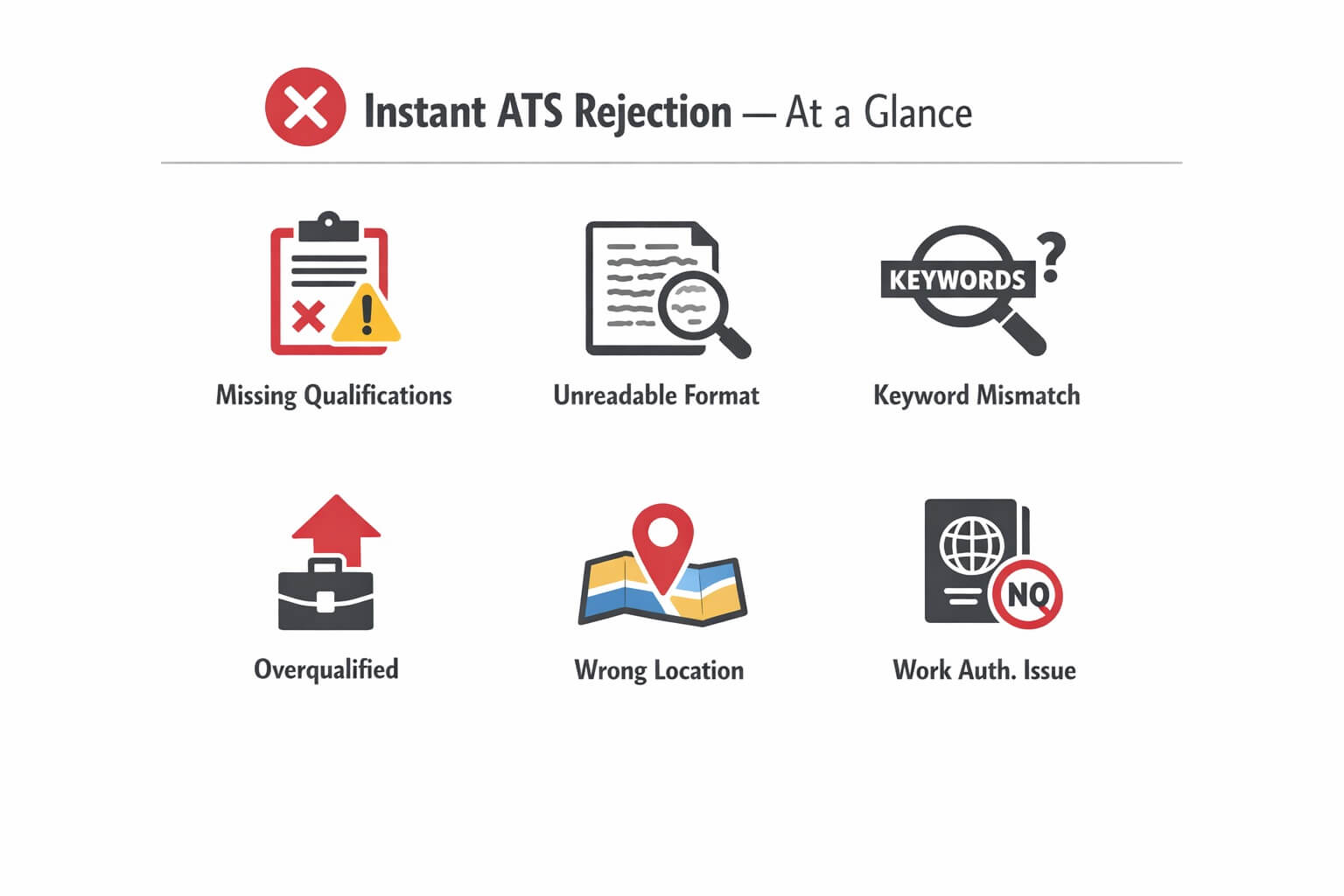
Missing Required Qualifications: ATS systems are often programmed with “knockout questions” or hard requirements. If a job requires U.S. citizenship for security clearance and you don’t explicitly state you’re a citizen, the system may auto-reject you. Similarly, if a position requires a specific certification, degree, or years of experience, not having these will trigger immediate rejection.
This is particularly common in regulated industries like aerospace and defense, government contracting, healthcare, and financial services. These fields often have non-negotiable requirements that ATS systems enforce strictly.
Resume Format Issues: Believe it or not, how your resume looks can get you rejected before anyone reads what it says. ATS systems struggle with creative resume formats, graphics and images, tables and text boxes, headers and footers containing important information, unusual fonts or font sizes, and non-standard section headings.
If your resume has a beautiful design with columns, graphics, and creative layouts, it might look great to humans but appear as gibberish to an ATS. The system can’t read your qualifications properly, so it rejects you.
Keyword Mismatch: ATS systems scan for specific keywords and phrases from the job description. If your resume doesn’t contain enough of these keywords, even if you have the right experience, you might be filtered out.
For example, if a job listing mentions “project management” multiple times but your resume only says “led projects,” the ATS might not make the connection. The system looks for exact or very close keyword matches.
Overqualification Filters: Some companies program their ATS to automatically reject candidates who appear overqualified. If you have 15 years of experience and apply for an entry-level role, the system might assume you’ll leave quickly or demand too much money, rejecting you before a human can consider whether you’re genuinely interested.
Geographic Restrictions: If a position isn’t open to remote work and you’re located outside the specified area, ATS systems may auto-reject you. Even if you’re willing to relocate, if you don’t explicitly state this, the system might filter you out based on your current address.
Work Authorization Issues: For positions in the U.S. and Canada, if you require visa sponsorship and the company isn’t offering it, this can trigger immediate rejection. Some ATS systems are programmed to screen out anyone who answers “yes” to “Will you require sponsorship?”
Why Internal Referrals Sometimes Don’t Help
One of the most frustrating situations is getting referred by someone inside the company, only to still receive an automated rejection. This seems illogical—if someone vouched for you, shouldn’t that matter?
Here’s what often happens: Many ATS systems process applications before the referral information is even attached to your profile. If you apply online and someone submits a referral separately, the system may reject you before the two pieces of information are connected.
Additionally, referrals don’t always override automatic screening criteria. If the system is programmed to reject anyone without a specific certification or clearance level, even a strong referral won’t bypass that hard requirement.
The timing also matters. If your referral submits your name after you’ve already been rejected, it may be too late for that referral to help. Some companies require referrals to be submitted before or simultaneously with your application.
Finally, not all referrals carry the same weight in automated systems. A referral from a senior manager might have system privileges to override rejections, while a referral from an individual contributor might only add a note that no one sees until after automated screening.
How to Tell If You’re Being Auto-Rejected
Certain patterns suggest you’re being filtered out by automated systems rather than rejected by human reviewers:
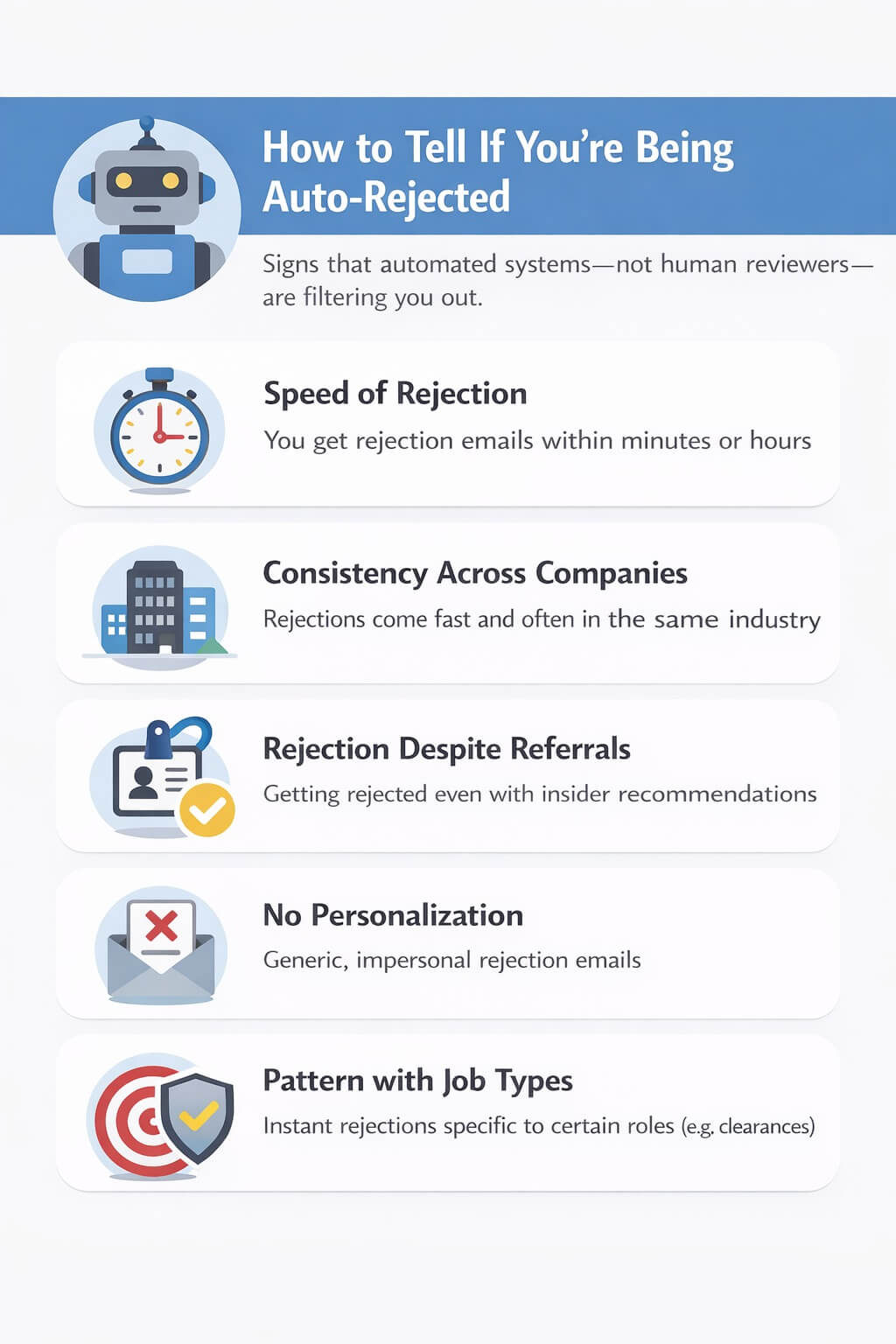
Speed of rejection: If you’re getting rejection emails within minutes to hours after applying, it’s almost certainly automated. Humans need time to review applications.
Consistency across companies: If you’re being rejected from dozens of different companies in the same industry with similar timing, it suggests a common factor triggering ATS filters.
Rejection despite referrals: When people inside companies vouch for you but you still get instantly rejected, automation is likely overriding human recommendations.
No personalization in rejections: Generic rejection emails that could apply to any candidate suggest automated decisions rather than individualized review.
Pattern with specific job types: If you get through to interviews for some types of roles but are instantly rejected for others (like those requiring clearances), specific requirements are likely triggering filters.
Is There Such a Thing as a “Blacklist”?
The concept of a formal “blacklist” is less common than people think, but there are situations where your profile might be flagged in ways that hurt your chances:
Company-specific flags: If you previously worked for a company and left under negative circumstances (termination, policy violations, burning bridges), you might be flagged as “not eligible for rehire” in their system. This isn’t industry-wide but company-specific.
Background check issues: If you have something in your background (criminal record, credit issues, employment verification problems) that failed a previous background check, some background check companies share this information, potentially affecting future applications.
Clearance denials: In industries requiring security clearances, if you’ve been denied clearance in the past, this information may be tracked and could affect future applications requiring similar clearances.
Multiple applications: Some ATS systems flag candidates who apply to too many positions at the same company too quickly, viewing this as spam or desperation. While not a true blacklist, it can hurt your chances.
However, an actual industry-wide blacklist where multiple unrelated companies coordinate to reject specific individuals is extremely rare and would raise serious legal concerns.
How to Contact Hiring Managers for Diagnostic Feedback
When automated rejections keep happening despite your best efforts, sometimes the only way forward is to reach out directly and ask for diagnostic help. Here’s how to do this professionally:
Who to contact: Hiring managers are your best bet—they own the hiring decision and can provide specific feedback. Recruiters for the position can explain screening criteria. HR Business Partners may have visibility into why candidates are filtered out. Talent acquisition managers understand ATS settings and can explain systematic issues.
How to find contact information: Search for the hiring manager on LinkedIn by looking at the department you applied to. Use professional email format guessing (firstname.lastname@company.com). Check the company’s “About” or “Team” page for departmental contacts. Use tools that find professional email addresses. Ask your referral to connect you directly.
What to say: Your message should be brief, professional, and focused on improvement rather than complaining. Here’s a template approach:
Subject line: Feedback Request – [Position Title] Application
Hi [Name], I recently applied for [position] at [company] (application submitted [date]) and received an automated rejection within [timeframe]. I’m reaching out not to request reconsideration, but to ask if you could provide any diagnostic feedback about why my application may have been filtered out. I’ve received consistently positive feedback on my resume from industry professionals, and I’m trying to understand if there’s a systemic factor I’m missing—such as ATS compatibility issues, missing required keywords, or qualification mismatches.
I’m asking specifically because:
- [relevant point, such as: “I was referred by [name] but still received an automated rejection”]
- [relevant point, such as: “This pattern has occurred across multiple applications in the industry”]
Any insight you could share would be genuinely helpful for improving my approach. Thank you for your time.
When to send this: Wait at least a few days after the rejection, but no more than two weeks. Send during business hours on a Tuesday, Wednesday, or Thursday. Avoid Monday mornings and Friday afternoons when people are busiest or winding down.
What not to do: Don’t express frustration or anger. Don’t demand an interview or reconsideration. Don’t write lengthy explanations of your qualifications. Don’t contact multiple people at the same company simultaneously. Don’t follow up more than once if you don’t receive a response.
Fixing ATS-Related Issues
If you suspect ATS problems are causing your rejections, here’s how to fix them:
Resume format overhaul: Use a simple, single-column format with standard section headings like “Experience,” “Education,” and “Skills.” Save as a .docx file or simple PDF. Avoid tables, text boxes, headers, and footers. Use standard fonts like Arial, Calibri, or Times New Roman. Remove any graphics, logos, or images.
Keyword optimization: Copy the job description and paste it into a word cloud generator to identify the most frequent terms. Include exact phrases from the job description in your resume where truthful and relevant. Use both acronyms and spelled-out versions (e.g., “ATS (Applicant Tracking System)”). Include industry-standard terminology even if you normally use different words for the same concepts.
Skills section enhancement: Create a comprehensive skills section with keywords from your target jobs. List technical skills, software proficiencies, certifications, and methodologies. Include both hard skills and relevant soft skills mentioned in job descriptions.
Qualification alignment: Only apply to jobs where you meet at least 80% of the stated requirements. For required qualifications (marked as “required” not “preferred”), meet 100% before applying. If a job requires 3-5 years of experience and you have 2, skip it—the ATS will likely auto-reject you.
Addressing Citizenship and Clearance Issues
In industries like aerospace, defense, and government contracting, citizenship and security clearance requirements cause more auto-rejections than any other single factor.
Be explicit about your status: Don’t assume the ATS will figure out you’re eligible. State clearly on your resume: “U.S. Citizen” or “Authorized to work in the U.S. without sponsorship” or “Current Secret Security Clearance” (if applicable). Answer screening questions accurately and completely.
Understand clearance implications: Many entry-level positions in defense say “clearance required” even though the company might sponsor clearances for the right candidate. However, if you can’t obtain a clearance (non-citizens typically can’t get security clearances), you’ll be auto-rejected from these positions no matter how qualified you are otherwise.
Target appropriate roles: If you’re not a citizen and can’t get clearance, filter out jobs with these requirements before applying. Applying to 100 positions you’re automatically ineligible for wastes your time and can frustrate companies that might otherwise consider you for other roles.
When the Problem Might Be Market-Related, Not You
Sometimes, despite doing everything right, job seekers face challenges that aren’t about their qualifications or application strategy:
Industry saturation: Some fields have far more qualified candidates than available positions. Aerospace engineering, for example, can have 300+ applicants for a single entry-level role.
Timing and budget cycles: Companies often pause hiring due to budget freezes, reorganizations, or economic uncertainty. You might be applying during a freeze period.
Internal candidate preference: Many companies post jobs publicly even when they have an internal candidate in mind, either because of policy requirements or to comply with legal obligations. Your application never really had a chance.
Overproduction of graduates: Some degree programs produce more graduates than the market can absorb, creating intense competition for limited positions.
Geographic limitations: If you’re only willing to work in specific cities or can’t relocate, this dramatically reduces available opportunities in some fields.
If you’ve fixed all the technical issues with your application but still aren’t getting interviews, market conditions might be the real barrier. This doesn’t mean give up—it means you may need to expand your strategy.
Alternative Approaches When Applications Aren’t Working
If traditional applications continue to fail despite optimization, consider these alternative pathways:
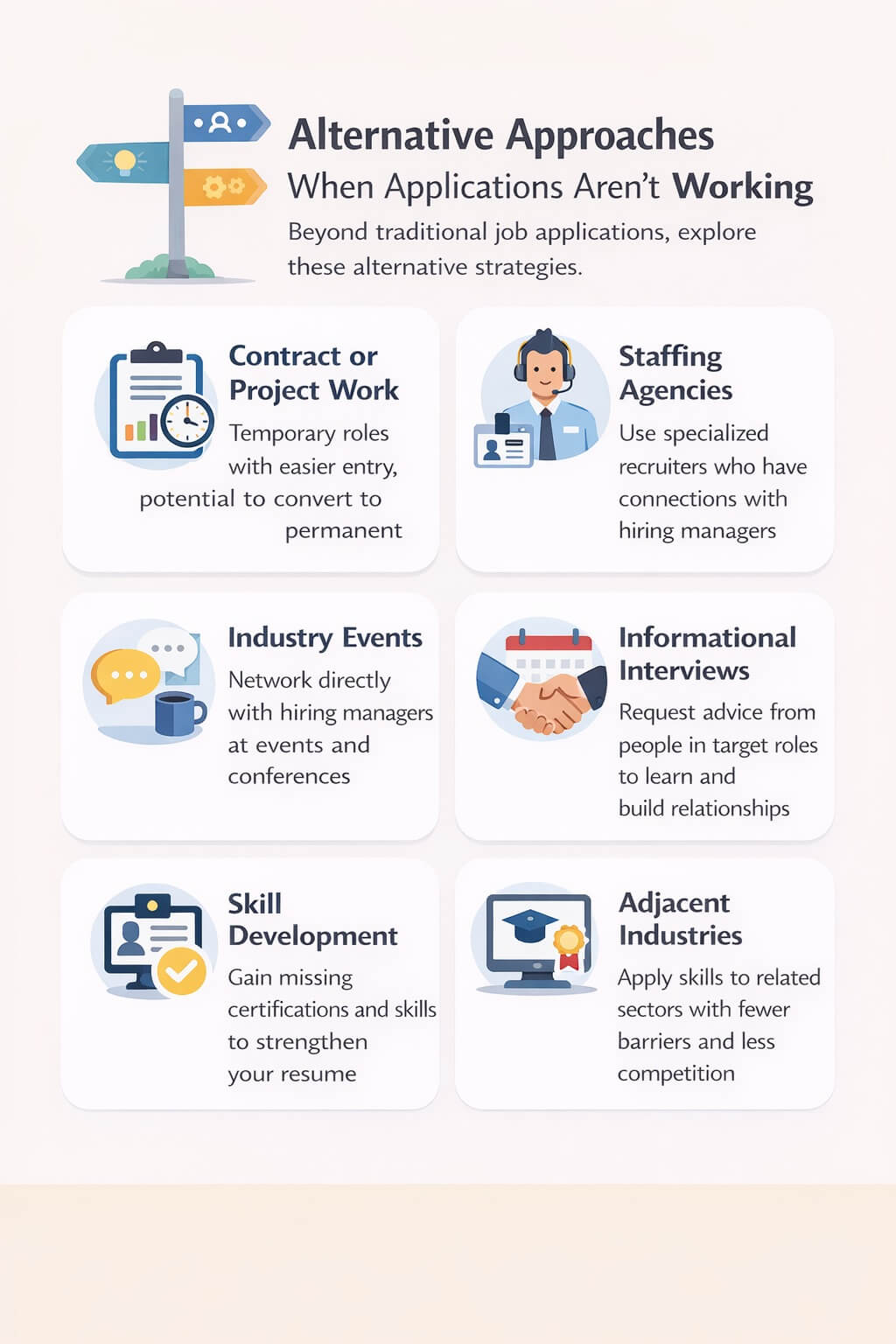
Contract or project work: Contract positions often have less stringent screening since they’re temporary. Once you’re in the door, you can prove yourself and potentially convert to permanent.
Staffing agencies: Specialized recruiters in your industry have relationships with hiring managers and can bypass some ATS screening. They can also provide honest feedback about your marketability.
Industry events and conferences: Meeting hiring managers face-to-face at industry events removes the ATS barrier entirely. Even virtual events can create networking opportunities.
Informational interviews: Request conversations with people in your target roles not to ask for a job, but to learn about their path and get advice. These often lead to opportunities.
Skill development and certification: If you keep getting rejected for lacking specific qualifications, invest time in gaining those credentials rather than continuing to apply without them.
Adjacent industries: If aerospace is saturated, consider applying your engineering skills in automotive, robotics, manufacturing, or other fields with similar technical requirements but potentially less competition.
The Mental Health Aspect of Repeated Rejection
Sending 600 applications and getting 600 rejections takes a serious toll on mental health. This is not just about job hunting strategy—it’s about maintaining your wellbeing through a difficult process.
Repeated rejection can lead to depression, anxiety, loss of confidence, and decreased motivation. It’s important to recognize that these reactions are normal and valid. You’re not weak or overly sensitive—constant rejection is genuinely difficult.
Protect your mental health by setting application limits (maybe 5-10 quality applications per week rather than mass applying), taking breaks from job searching, maintaining routines unrelated to job hunting, connecting with supportive people who understand your struggle, and considering talking to a counselor if rejection is significantly affecting your daily life.
Remember: rejection says nothing about your worth as a person or even necessarily your qualifications. It often reflects mismatches, timing, or technical issues—not you being “not good enough.”
Moving Forward: A Systematic Approach
If you’re facing constant auto-rejections, here’s a systematic approach to diagnose and fix the issue:
Week 1 – Diagnostic Phase: Request feedback from 3-5 hiring managers using the email template provided earlier. Have a professional resume reviewer specifically check for ATS compatibility. Run your resume through free ATS scanners online to see what they detect. Review every job you’ve applied to and note any common requirements you don’t meet.
Week 2 – Fix Technical Issues: Reformat your resume using a simple, ATS-friendly template. Optimize for keywords from your target jobs. Explicitly state citizenship, clearance status, and work authorization. Ensure your LinkedIn profile matches your resume exactly.
Week 3 – Strategic Refinement: Apply only to jobs where you meet 80%+ of requirements. Focus on quality over quantity—5 well-targeted, optimized applications beat 50 generic ones. Set up informational interviews with people in your target roles. Research companies specifically hiring entry-level candidates in your field.
Week 4 – Expand Approach: Reach out to staffing agencies specializing in your industry. Attend industry networking events or webinars. Consider contract or temporary positions. Look at adjacent industries where your skills transfer.
Final Thoughts
Constant auto-rejection is frustrating and demoralizing, but it’s usually fixable once you identify the root cause. For most people, the issue isn’t an industry blacklist or being “unhirable”—it’s technical problems with how applications are being processed, qualification mismatches, or simply needing to adjust strategy.
Start by fixing the technical issues: ATS-friendly formatting, keyword optimization, and explicit qualification statements. Then reach out for diagnostic feedback from people who can actually see why you’re being filtered out. Finally, if applications continue to fail, shift to alternative approaches like networking, contract work, and staffing agencies.
Most importantly, remember that this process takes time and persistence. Many successful professionals faced similar struggles before landing their first role. The difference between those who eventually succeed and those who give up is simply continuing to adapt their approach until something works.
You’re not alone in this struggle, and it doesn’t mean you’re not qualified. Keep refining your approach, protect your mental health through the process, and trust that with the right strategy, you’ll find your way past those auto-rejection algorithms.