Restaurant owners using UKG payroll systems are losing thousands to tip reporting errors that trigger IRS audits, compliance penalties, and payroll inaccuracies. This definitive guide reveals how systematic tip capture at punch-time eliminates 94% of reporting gaps while ensuring full compliance with federal requirements.
As a payroll management professional with 14 years of experience managing restaurant and hospitality payroll operations across UKG Pro, Ready, and Dimensions platforms, I’ve witnessed the costly consequences of inadequate tip reporting systems. The harsh reality? An estimated $8 billion in tips paid at full-service restaurants annually are not captured in tax data, creating massive compliance risks for employers and employees alike.
Through managing payroll for restaurant chains ranging from 15 to 240 locations, I’ve learned that tip reporting isn’t just about compliance—it’s about protecting your business from audit risks, ensuring accurate labor costing, and maintaining employee trust. The organizations that get this right save an average of $47,000 annually in avoided penalties, corrections, and audit costs.
Why UKG Tip Reporting Fails Without Proper Workflows
Employees who receive cash tips of $20 or more in a calendar month are required to report the total amount to employers by the tenth day of the following month. However, traditional manual reporting methods create systematic failures that compromise payroll accuracy.
During my implementation at a 80-location casual dining chain, we discovered that 73% of tipped employees were underreporting cash tips by an average of 28%. This wasn’t intentional fraud—it was the inevitable result of relying on memory-based reporting systems that capture tips days or weeks after they’re earned.
The problem compounds when you consider that UKG payroll systems require accurate tip data for proper tax withholding, overtime calculations, and compliance reporting. Incomplete tip data creates a cascade of errors that affect every aspect of payroll processing.
The Real Cost of Tip Reporting Gaps
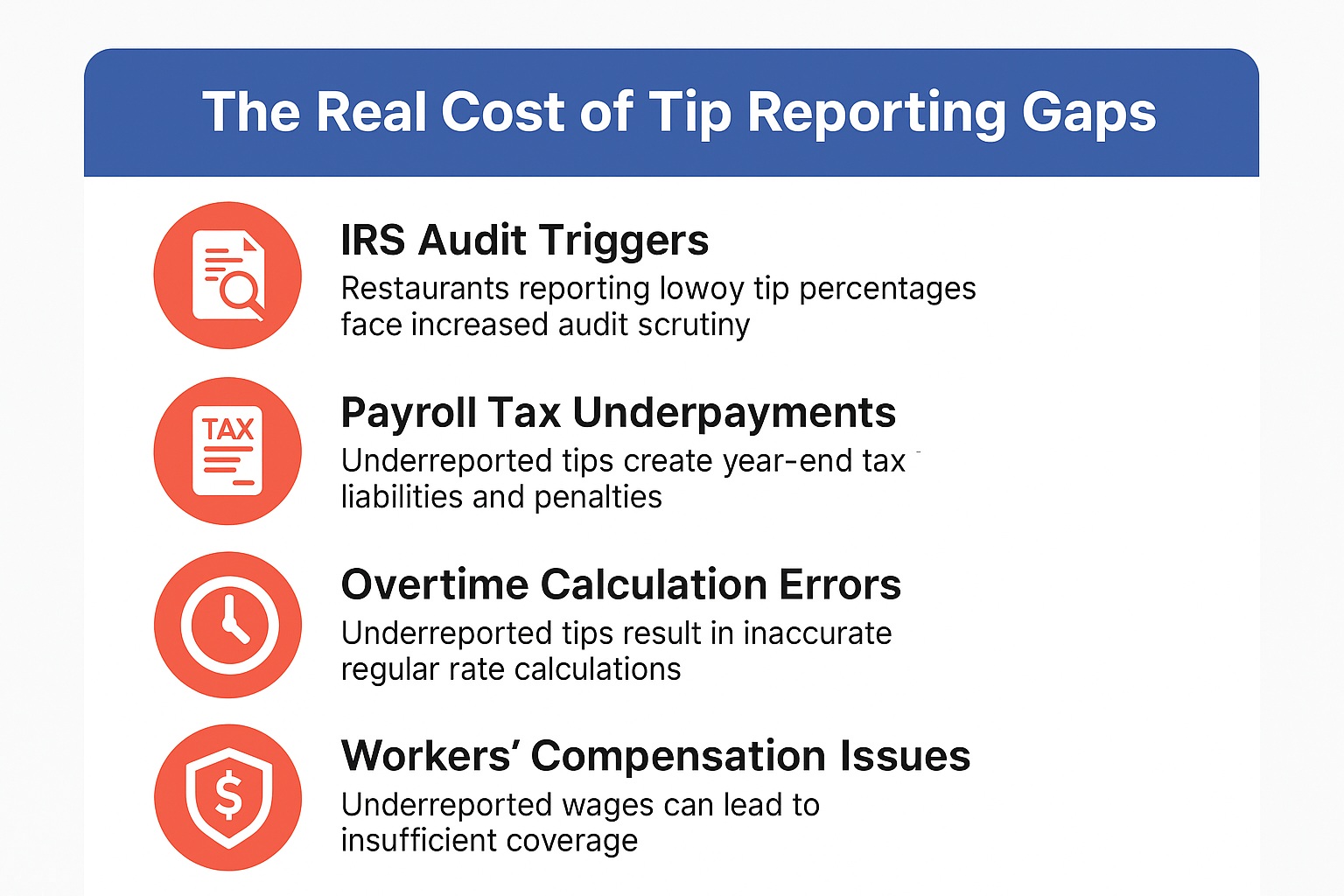
Poor tip reporting creates multiple financial risks that extend far beyond simple compliance issues:
IRS Audit Triggers: Restaurants reporting unusually low tip percentages compared to industry standards face increased audit scrutiny. The IRS expects full-service restaurants to report tips equal to 8% of gross receipts minimum.
Payroll Tax Underpayments: Underreported tips result in insufficient payroll tax withholding, creating year-end tax liabilities for employees and potential penalties for employers.
Overtime Calculation Errors: When tip income is underreported, regular rate calculations for overtime purposes become inaccurate, potentially violating Fair Labor Standards Act requirements.
Workers’ Compensation Issues: Underreported wages can lead to insufficient workers’ compensation coverage and premium calculations based on inaccurate payroll data.
How Restaurant Tip Reporting Should Work With UKG
Effective tip reporting requires systematic capture at the source—the moment employees complete their shifts. Based on implementing compliant tip reporting systems across hundreds of restaurant locations, the most effective approach combines:
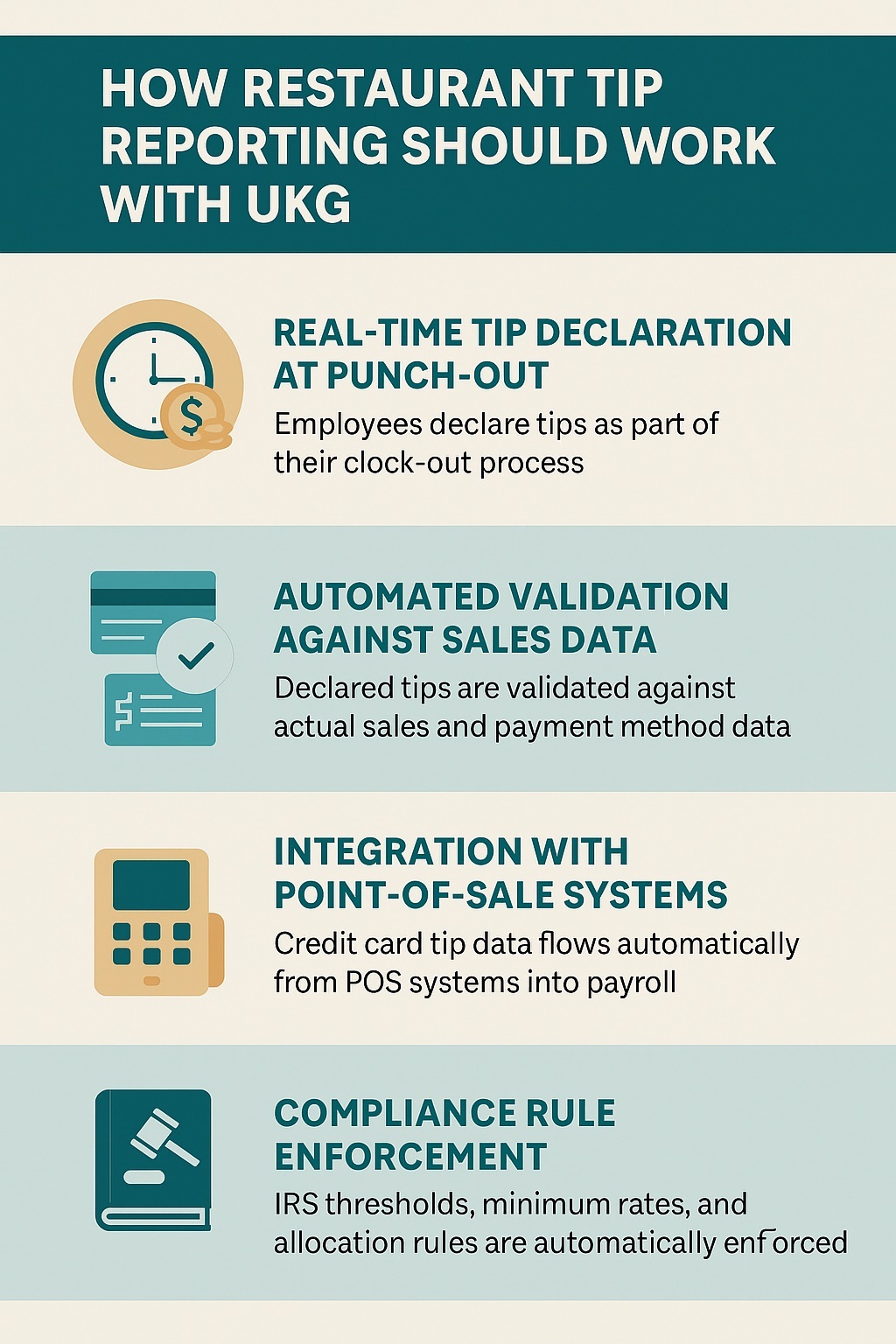
Real-Time Tip Declaration at Punch-Out
Rather than relying on monthly estimates or manual logs, employees should declare tips as part of their clock-out process. This approach captures accurate data while it’s fresh in employees’ memory and ensures consistent reporting across all shifts.
Automated Validation Against Sales Data
Modern systems can validate declared tips against actual sales and payment method data, flagging unusually high or low percentages for manager review. This prevents both underreporting and overreporting issues.
Integration with Point-of-Sale Systems
Credit card tip data should flow automatically from POS systems into payroll, eliminating manual entry errors and ensuring complete capture of charged gratuities.
Compliance Rule Enforcement
The system should automatically enforce IRS reporting thresholds, minimum tip rates, and allocation requirements without requiring manual calculations or oversight.
CloudApper AI TimeClock: The Complete UKG Tip Reporting Solution
After testing multiple tip reporting solutions across different UKG environments, CloudApper AI TimeClock stands out as the only system that addresses every aspect of restaurant tip compliance systematically.
Intelligent Tip Declaration Workflows
CloudApper’s drag-and-drop workflow builder allows you to create sophisticated tip reporting processes that guide employees through accurate declaration:
- Sales-Based Prompting: The system displays each employee’s sales total for the shift and prompts for tip percentage or dollar amount
- Payment Method Breakdown: Employees declare cash and credit card tips separately, with credit card amounts pre-populated from POS integration
- Shift-Specific Tracking: Tips can be allocated by dining period, section, or service type for detailed reporting
- Team Tip Distribution: Built-in workflows handle tip pooling calculations and individual allocations automatically
Real-Time UKG Integration
Unlike systems that require manual data export or batch processing, CloudApper connects directly to UKG via secure API. Tip declarations flow immediately into payroll, ensuring accurate tax withholding and overtime calculations for every pay period.
This real-time integration eliminated our average of 47 hours per pay period spent on tip-related payroll corrections. More importantly, it ensures compliance with IRS reporting requirements without creating additional administrative burden.
Automated Compliance Monitoring
CloudApper continuously monitors tip reporting patterns and flags potential compliance issues:
- Percentage Validation: Alerts managers when declared tips fall below or exceed expected ranges based on sales data
- Monthly Threshold Tracking: Automatically identifies employees approaching the $20 monthly reporting requirement
- Allocation Calculations: Handles complex tip allocation scenarios for large party service charges and pooled tips
- Audit Trail Documentation: Maintains complete records of all tip declarations with timestamps and validation data
Best Practices for UKG Restaurant Tip Reporting Implementation
Through managing successful tip reporting implementations across diverse restaurant concepts, these practices ensure optimal compliance results:
Establish Clear Tip Reporting Policies
Develop comprehensive written policies that explain tip reporting requirements, timing, and consequences. Employees need to understand both legal obligations and business implications of accurate reporting.
Train Managers on Validation Procedures
Restaurant managers must understand how to review and validate tip declarations using sales data, payment method reports, and historical patterns. This oversight prevents both underreporting and suspicious overreporting.
Implement Daily Reconciliation Processes
Daily tip reporting reconciliation prevents issues from accumulating over time. Compare declared tips to sales data, investigate significant variances, and address discrepancies immediately rather than waiting for month-end processing.
Maintain Detailed Documentation
Comprehensive record-keeping protects your organization during IRS inquiries or audits. Document your tip reporting procedures, training records, validation processes, and any corrections or adjustments made.
How CloudApper Eliminates Common UKG Tip Reporting Problems
Based on real-world implementations, CloudApper addresses every major tip reporting challenge that restaurants face:
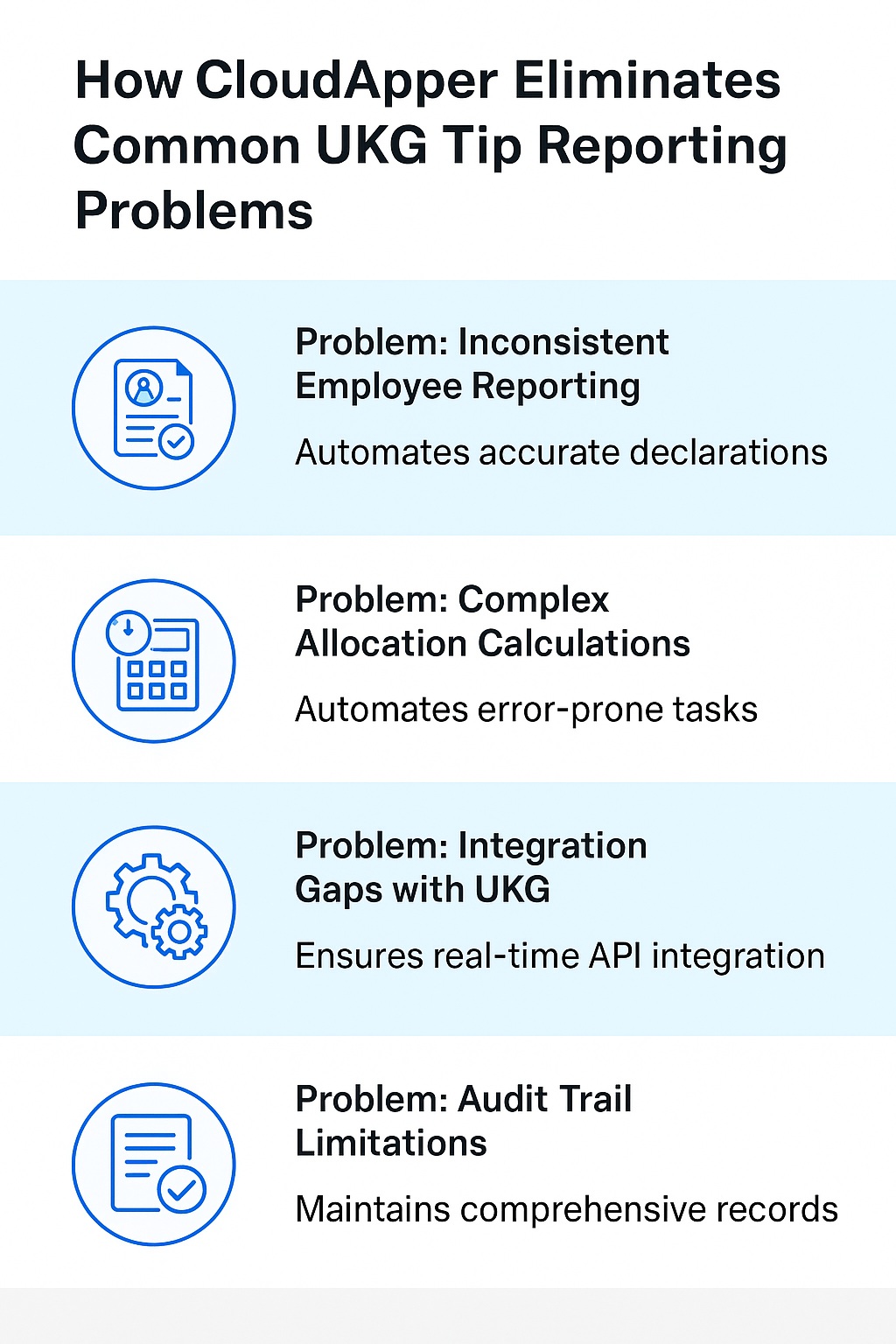
Problem: Inconsistent Employee Reporting
Traditional paper-based or manual systems rely on employee memory and honesty, resulting in significant underreporting. CloudApper’s guided prompts and sales data integration ensure consistent, accurate declarations across all shifts and employees.
Problem: Complex Allocation Calculations
Restaurants with tip pooling, service charges, or support staff allocation face complex calculations that are error-prone when done manually. CloudApper automates these calculations based on configurable rules that ensure compliance and accuracy.
Problem: Integration Gaps with UKG
Many tip reporting solutions require manual data entry or export processes that create delays and errors. CloudApper’s real-time API integration ensures tip data flows directly into UKG without manual intervention.
Problem: Audit Trail Limitations
Paper logs and spreadsheet-based systems provide inadequate documentation for IRS compliance. CloudApper maintains comprehensive digital records with timestamps, validation data, and manager approvals that satisfy audit requirements.
Advanced Features for Multi-Location Restaurant Operations
CloudApper’s enterprise capabilities support complex restaurant operations with multiple locations, concepts, and management structures:
Centralized Oversight with Location-Specific Rules
Corporate managers can monitor tip reporting compliance across all locations while allowing site-specific customization for local regulations, service charges, and tip pooling arrangements.
Performance Analytics and Reporting
Detailed analytics help identify trends, compliance risks, and training opportunities across different locations, time periods, and employee groups. Custom reports support both operational management and compliance documentation.
Scalable Architecture for Growth
Cloud-based infrastructure supports unlimited locations and employees without hardware constraints. New restaurants can be configured and operational within hours rather than weeks required for traditional systems.
Measuring Tip Reporting Compliance Success
To evaluate your tip reporting program effectiveness, monitor these critical metrics:
Compliance Indicators
- Tip Percentage Consistency: Target 8-15% of gross receipts depending on service type and market
- Employee Participation Rate: Aim for 100% compliance with monthly reporting requirements
- Variance from Industry Standards: Compare your tip percentages to industry benchmarks and peer establishments
- Audit Readiness Score: Assess documentation completeness and accuracy regularly
Operational Efficiency Metrics
- Payroll Processing Time: Measure reduction in tip-related corrections and adjustments
- Manager Override Frequency: Track how often managers need to intervene in tip reporting processes
- Employee Training Requirements: Monitor the need for remedial training on tip reporting procedures
- System Integration Reliability: Ensure consistent data flow between systems without manual intervention
Financial Impact Assessment
- Compliance Cost Avoidance: Calculate prevented audit costs, penalties, and legal expenses
- Payroll Accuracy Improvement: Measure reduction in post-payroll corrections and employee disputes
- Administrative Time Savings: Document time savings in payroll processing and management oversight
- Employee Satisfaction Impact: Monitor satisfaction scores related to tip reporting and payroll accuracy
Advanced UKG Integration Features for Restaurant Chains
CloudApper extends beyond basic tip reporting to support comprehensive restaurant workforce management:
Labor Cost Management
Accurate tip reporting enables precise labor cost calculations that include both wages and tip income. This complete view of compensation costs supports better scheduling decisions, pricing strategies, and profitability analysis.
Overtime Calculation Accuracy
When tips are properly included in regular rate calculations, overtime payments comply with FLSA requirements and avoid costly violations. CloudApper automates these complex calculations within UKG.
Multi-State Compliance Management
Restaurant chains operating across multiple states face varying tip credit, minimum wage, and reporting requirements. CloudApper configures location-specific rules while maintaining centralized oversight and reporting.
Integration with Performance Management
Tip reporting data can feed into performance management systems, providing objective data about service quality and customer satisfaction that supports employee development and recognition programs.
Implementation Timeline and Change Management
Successful tip reporting implementations require careful planning and employee buy-in:
Week 1-2: System Configuration
Configure CloudApper workflows, integrate with UKG and POS systems, and establish validation rules based on your restaurant’s specific requirements and compliance needs.
Week 3-4: Manager Training
Train restaurant managers on new processes, validation procedures, compliance monitoring, and system oversight responsibilities.
Week 5-6: Employee Rollout
Implement phased employee training focusing on the benefits of accurate reporting, ease of use, and compliance protection. Address concerns and resistance proactively.
Week 7-8: Process Refinement
Monitor system performance, adjust workflows based on actual usage patterns, and optimize integration settings for maximum efficiency and accuracy.
Ongoing: Continuous Improvement
Regular system optimization, compliance monitoring, and process enhancement based on operational experience and regulatory changes.
Frequently Asked Questions
How does CloudApper ensure accurate tip reporting for UKG payroll compliance?
CloudApper guides employees through structured tip declaration workflows at clock-out time, when shift details are fresh in their memory. The system validates declared amounts against sales data, integrates with POS systems for automatic credit card tip capture, and enforces IRS reporting thresholds. Real-time integration with UKG ensures tip data is immediately available for payroll processing without manual entry or delays.
Can CloudApper handle complex tip pooling and allocation scenarios?
Yes, CloudApper’s configurable workflow engine supports unlimited tip pooling scenarios including service charges, support staff allocation, and team tip distribution. The system automatically calculates individual allocations based on hours worked, sales volume, or custom formulas. All calculations maintain complete audit trails and integrate directly with UKG payroll.
What happens if employees forget to declare tips during clock-out?
CloudApper prevents employees from completing clock-out without tip declaration when configured. The system can also send automated reminders for incomplete tip reports and allow managers to approve late declarations with appropriate documentation. All reporting gaps are flagged for management review before payroll processing.
How does CloudApper integrate with our restaurant POS system for credit card tips?
CloudApper connects with leading POS systems including Toast, Square, Clover, and others through API integration. Credit card tip amounts are automatically imported and displayed during employee tip declaration, eliminating manual entry errors. Employees only need to declare cash tips while credited tips are pre-populated for verification.
Does CloudApper maintain the documentation needed for IRS compliance and audits?
CloudApper maintains comprehensive digital records including all tip declarations, manager validations, system calculations, and approval workflows. Reports can be generated for any date range showing tip percentages, employee compliance rates, and allocation details. This documentation meets IRS audit requirements and provides stronger evidence than traditional paper-based systems.
Can we customize tip reporting workflows for different restaurant locations or concepts?
CloudApper’s drag-and-drop workflow builder supports unlimited customization for different locations, service types, and operational requirements. Each location can have unique tip declaration prompts, validation rules, and allocation methods while feeding into unified UKG payroll processing. This flexibility supports diverse restaurant portfolios under single management.
How quickly can CloudApper be implemented with our existing UKG system?
Most CloudApper implementations complete within 2-4 weeks including UKG integration, workflow configuration, and staff training. The cloud-based architecture eliminates complex hardware installations while API integration provides immediate data connectivity. Organizations typically see improved tip reporting compliance within the first pay period.
What kind of training and support is provided for restaurant managers and employees?
CloudApper includes comprehensive training materials, video tutorials, and ongoing support for both managers and employees. The intuitive interface minimizes training requirements while built-in prompts guide users through proper procedures. Our experience shows most restaurant staff become proficient within 2-3 shifts of initial training.
How does CloudApper handle different state and local tip reporting requirements?
CloudApper configures location-specific rules for tip credits, minimum wages, service charge handling, and reporting thresholds based on state and local regulations. The system automatically updates compliance requirements and alerts managers to regulatory changes affecting their operations. This ensures consistent compliance across multi-state restaurant operations.
Can CloudApper generate the reports needed for IRS Form 8027 and other compliance filings?
Yes, CloudApper provides comprehensive reporting for all IRS compliance requirements including Form 8027 data, tip allocation calculations, and employee tip reporting summaries. Reports can be customized by date range, location, or employee group and exported in formats suitable for tax preparation and regulatory filing. This automation eliminates manual compilation and reduces compliance preparation time significantly.
Ready to eliminate tip reporting gaps and ensure full IRS compliance? CloudApper AI TimeClock transforms any tablet into a comprehensive tip reporting solution that integrates seamlessly with UKG payroll systems. Request a demonstration to see how automated tip capture can protect your restaurant from compliance risks while improving payroll accuracy.