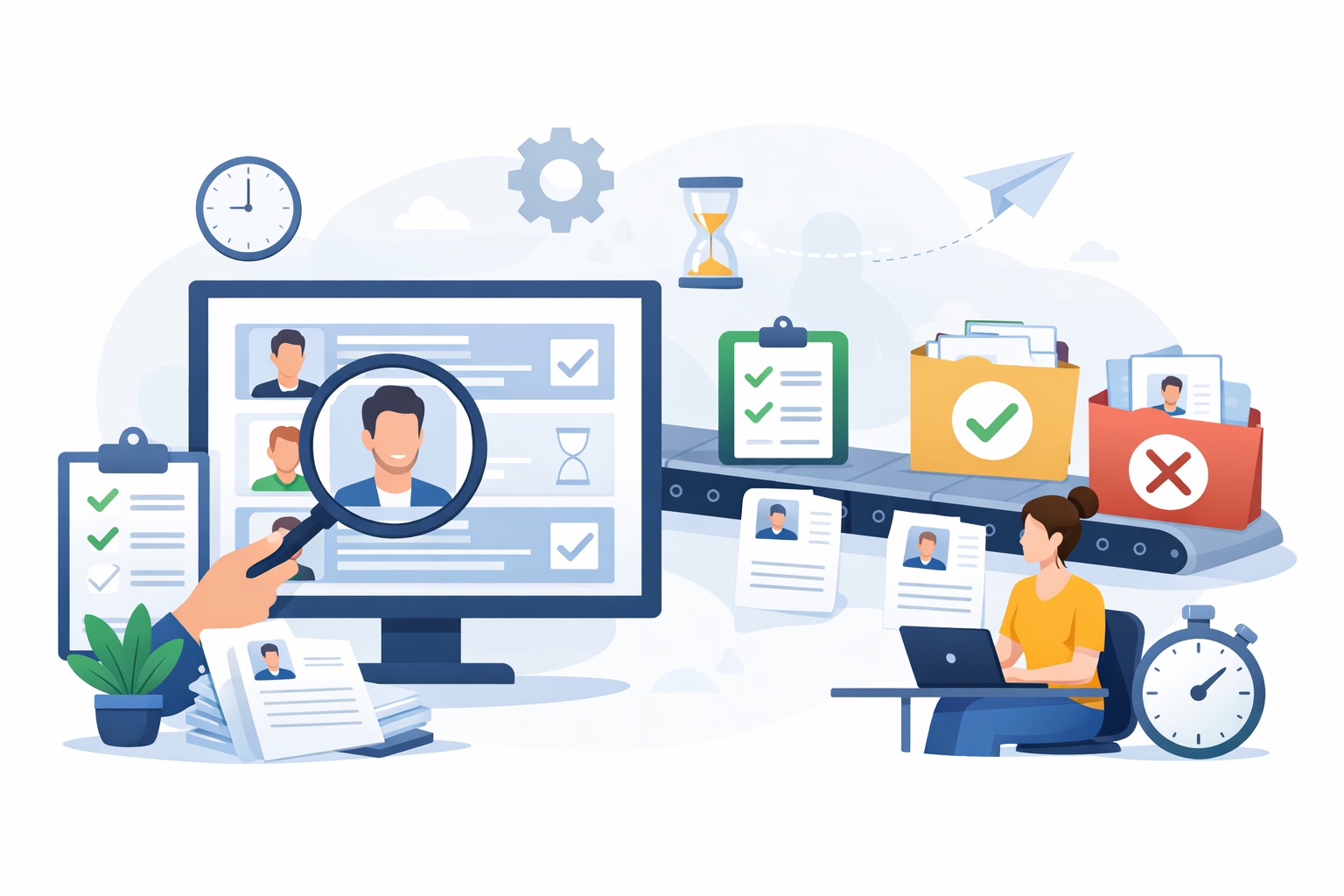
Choosing an Applicant Tracking System should be straightforward. After all, you’re just picking software to manage job applications, right? Yet many companies find themselves trapped in endless evaluation cycles, sometimes stretching beyond a year. If your ATS selection process feels stuck in neutral, you’re not alone.
The average company spends 3-12 months selecting an ATS, but the reality is that many drag on far longer. When teams conduct multiple trials of the same systems, second-guess previous decisions, or keep adding new requirements, the process can stretch past the one-year mark—creating frustration, wasted resources, and continued inefficiencies in hiring.
Why ATS Selection Drags On
Too Many Cooks in the Kitchen
The biggest slowdown? Too many decision-makers with conflicting priorities. HR wants ease of use. IT demands security features. Finance watches the budget. Recruiters need speed. When everyone has veto power but no one takes ownership, decisions stall.
The Perfect System Myth
Many teams fall into the trap of searching for a system that does everything perfectly. The truth is, no ATS will check every single box. When decision-makers keep saying “it’s not giving me what I want” after reviewing multiple options, they’re often chasing perfection that doesn’t exist.
Feature Overload
Modern ATS platforms pack in hundreds of features. During demos, vendors showcase everything their system can do, which actually makes decisions harder. Teams get overwhelmed comparing features they may never use, losing sight of what they actually need day-to-day.
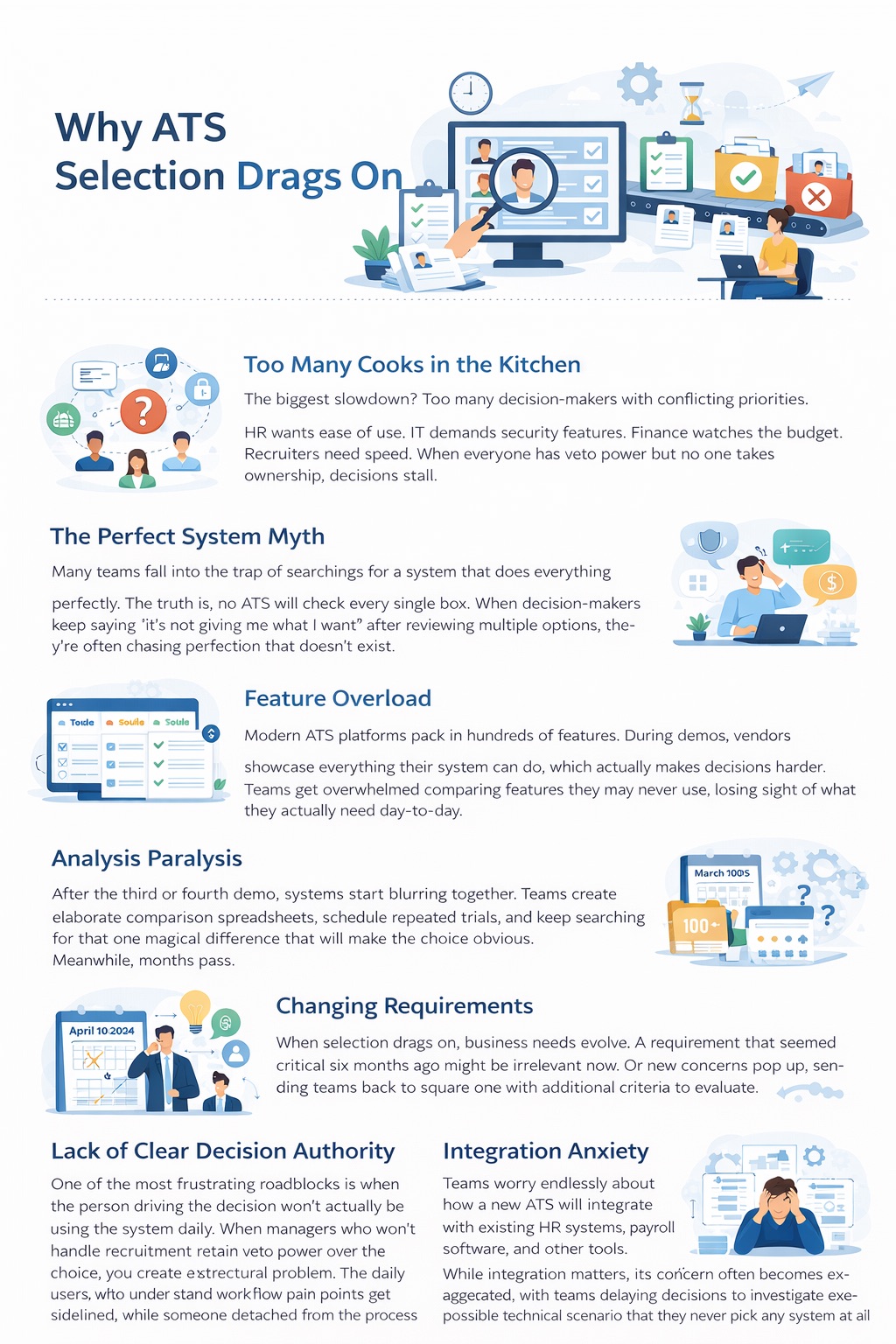
Analysis Paralysis
After the third or fourth demo, systems start blurring together. Teams create elaborate comparison spreadsheets, schedule repeated trials, and keep searching for that one magical difference that will make the choice obvious. Meanwhile, months pass.
Changing Requirements
When selection drags on, business needs evolve. A requirement that seemed critical six months ago might be irrelevant now. Or new concerns pop up, sending teams back to square one with additional criteria to evaluate.
Lack of Clear Decision Authority
One of the most frustrating roadblocks is when the person driving the decision won’t actually be using the system daily. When managers who won’t handle recruitment retain veto power over the choice, you create a structural problem. The daily users who understand workflow pain points get sidelined, while someone detached from the process keeps raising objections without offering clear direction.
Integration Anxiety
Teams worry endlessly about how a new ATS will integrate with existing HR systems, payroll software, and other tools. While integration matters, this concern often becomes exaggerated, with teams delaying decisions to investigate every possible technical scenario rather than trusting that modern systems are built to integrate smoothly.
Fear of Making the Wrong Choice
The higher the investment and the longer you’ve been searching, the more pressure mounts to make the “right” decision. This fear can freeze decision-making entirely. Teams become so worried about picking the wrong system that they never pick any system at all.
How Long Should It Really Take?
For small to mid-sized companies, a reasonable ATS selection timeline is:
- Research phase: 2-4 weeks
- Demo and trials: 4-6 weeks
- Final evaluation and decision: 2-3 weeks
- Contract negotiation: 1-2 weeks
Total: 2-4 months from start to signed contract
Larger organizations with complex needs might extend this to 4-6 months, but anything beyond six months suggests a process problem, not a software problem.
How to Speed Up Your Decision
Start with Clear Requirements
Before looking at any system, write down your must-haves versus nice-to-haves. Be ruthlessly honest. If your team hasn’t posted a job on social media in two years, you don’t need advanced social recruiting features as a requirement.
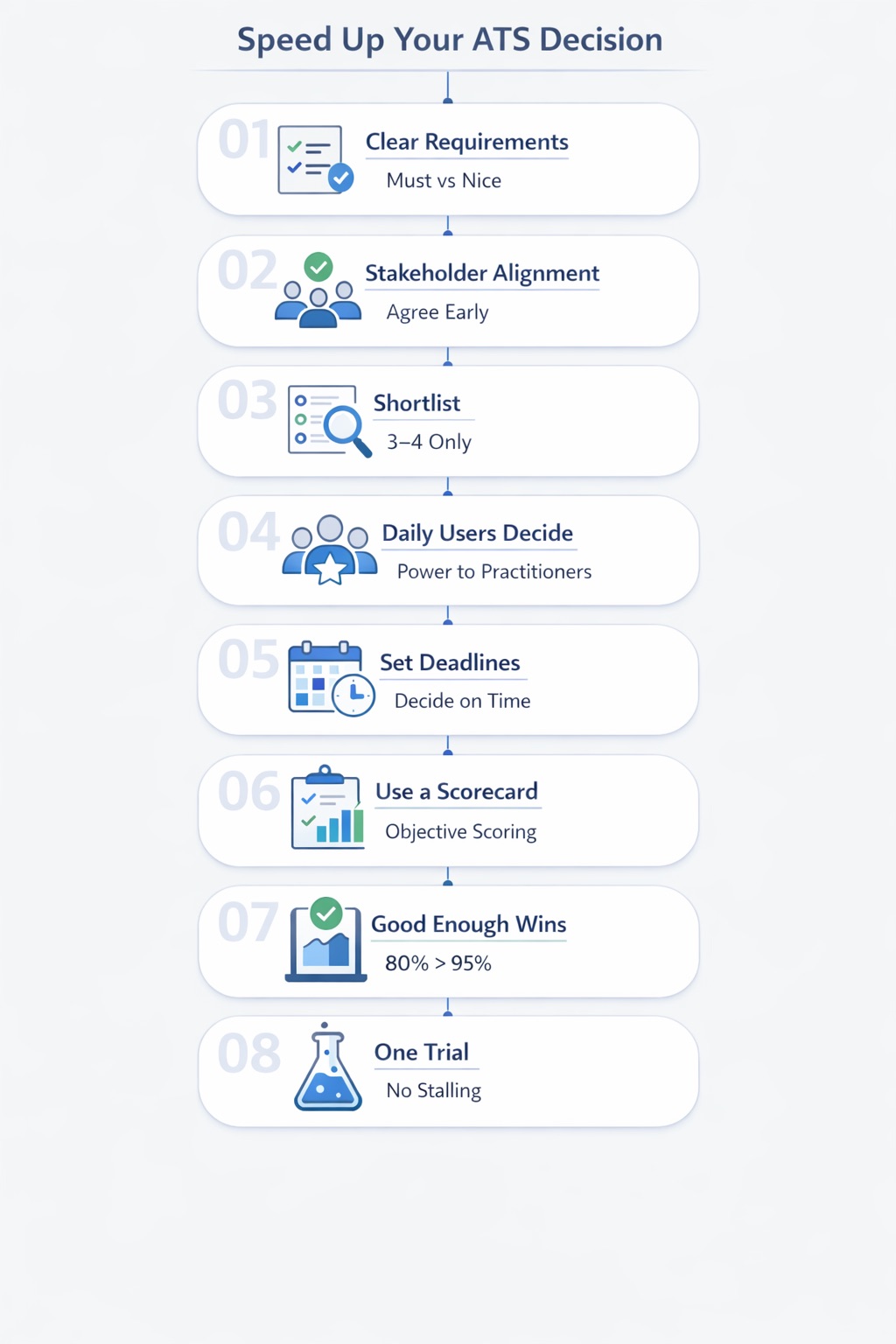
Get agreement from all stakeholders on these requirements upfront. This prevents moving goalposts later.
Limit Your Shortlist
Resist the urge to demo every ATS on the market. Research thoroughly, then pick your top 3-4 systems for detailed evaluation. More than that creates decision fatigue.
Empower the Daily Users
The people who will use the system every day should have the strongest voice in the decision. If a manager who won’t be recruiting anymore has veto power, your process has a structural problem that needs addressing.
Set Decision Deadlines
Create a timeline with firm dates for each phase. More importantly, set a final decision deadline and stick to it. Parkinson’s Law applies here: work expands to fill the time available. Without a deadline, evaluation will continue indefinitely.
Use a Scorecard
Create a simple scoring system based on your requirements. After each demo or trial, score the system immediately while it’s fresh. This creates objective data to compare against later, rather than relying on fading memories.
Accept “Good Enough”
The best ATS is the one you actually implement and use. A system that meets 80% of your needs and goes live next month is better than a system that meets 95% of your needs but takes another six months to select.
One Trial Per System
Multiple sandbox trials of the same system rarely reveal new information. If you’re on your third trial of a platform, you’re stalling, not evaluating. One thorough trial with real-world scenarios should tell you what you need to know.
Red Flags Your Process Is Stuck
Watch for these warning signs:
- You’ve been evaluating for over six months
- You’re doing repeat trials of systems you’ve already tested
- Decision-makers can’t articulate what’s missing from top choices
- The person blocking the decision won’t be using the system
- Requirements keep changing or expanding
- You’re comparing features that don’t relate to your actual hiring process
- Team members who will use the system daily aren’t empowered to decide
- You’ve created comparison spreadsheets with 50+ criteria
- Demos start blending together and you can’t remember what differentiates systems
The Hidden Costs of Delayed Decisions
While your team debates systems, real costs accumulate:
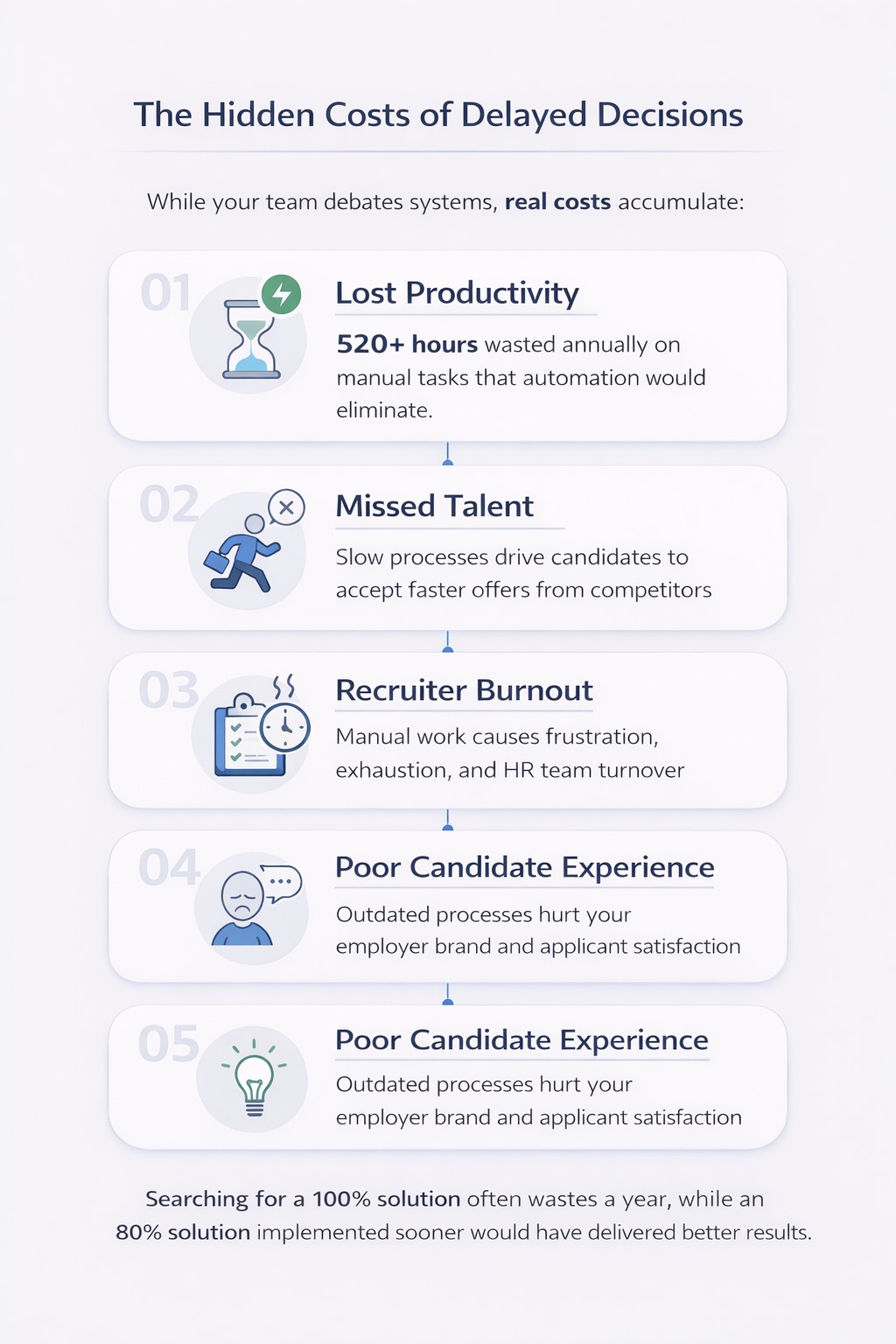
Lost productivity: Recruiters continue spending hours on manual tasks that automation would eliminate. If your team wastes just 10 hours per week on inefficient processes, that’s 520 hours annually—equivalent to a quarter of a full-time employee’s work year.
Missed talent: Slow, clunky application processes drive candidates away. In competitive hiring markets, the best candidates apply to multiple positions and accept the first good offer. Your outdated process could mean losing talent to competitors with smoother systems.
Recruiter burnout: Manual screening, scheduling coordination, and administrative work drain energy that should go toward strategic activities like candidate relationship building and employer branding. Prolonged inefficiency leads to frustration and turnover among your HR team.
Poor candidate experience: Applicants notice when your hiring process feels outdated. Slow responses, unclear communication, and complicated application forms all reflect poorly on your employer brand.
The irony? Many teams waste a year searching for the perfect 100% solution when implementing an 80% solution six months earlier would have delivered better results.
When to Escalate
If your selection process shows these red flags and informal conversations haven’t helped, it may be time to escalate to senior leadership. Frame it around business impact: delays in implementing an ATS mean continued inefficiency, poor candidate experience, and potentially lost talent.
The Bottom Line
ATS selection doesn’t need to take a year. With clear requirements, empowered end-users, firm deadlines, and acceptance that no system is perfect, most companies can make a solid decision in 2-4 months.
Remember: the goal isn’t to find the perfect system. The goal is to find a good system that solves your current problems and get it implemented so you can start seeing benefits.
Your team’s time is valuable. Every month spent in endless evaluation is a month you could have been using a new system to hire better and faster. Sometimes the best decision is simply to make a decision and move forward.
How AI is Transforming the ATS Landscape
While traditional ATS platforms handle job postings, application tracking, and basic workflow management, a new generation of AI-powered recruitment tools is changing what’s possible in talent acquisition. These tools don’t replace your ATS—they enhance it by adding intelligent automation to the most time-consuming parts of hiring.
What AI Recruitment Tools Actually Do
AI recruitment assistants automate tasks that traditionally consume hours of recruiter time:
Resume screening and ranking: Instead of manually reviewing hundreds of resumes, AI analyzes each one contextually, understanding not just keywords but the full picture of a candidate’s experience, skills, and fit for the role. Top candidates are ranked and surfaced automatically.
Intelligent candidate assessment: AI can conduct initial screening through conversational interviews, asking personalized follow-up questions based on resume content and scoring responses against job requirements. This goes far beyond simple keyword matching.
Automated scheduling: AI handles the endless back-and-forth of interview scheduling by syncing with calendars, sending invites, managing confirmations, and handling reschedules—all without human intervention.
Candidate engagement: AI keeps applicants informed through automated but personalized communications via email, SMS, and chat. This prevents candidate drop-off and maintains a positive experience even when recruiters are handling high application volumes.
Bias reduction: Well-designed AI tools can help minimize unconscious bias by evaluating candidates based on skills and qualifications rather than demographic factors, creating more equitable shortlists.
The Pros of AI-Powered Recruitment
AI recruitment tools deliver measurable benefits:
- Dramatic time savings: Tasks that take hours happen in minutes. Resume screening that might take a recruiter several hours per role can be completed almost instantly.
- Better candidate experience: Instant responses, clear communication, and simplified application processes keep candidates engaged and reflect well on your employer brand.
- Reduced recruiter burnout: By handling repetitive administrative tasks, AI frees recruiters to focus on relationship building, interviewing, and strategic hiring decisions.
- Scalability: AI handles high-volume hiring scenarios effortlessly, making it possible for small teams to manage large recruitment campaigns.
- Consistency: AI applies the same criteria to every candidate, ensuring fair and systematic evaluation.
- Lower drop-off rates: Conversational, mobile-friendly application processes keep candidates engaged instead of abandoning lengthy forms.
The Considerations and Limitations
AI recruitment tools aren’t without challenges:
Integration requirements: These tools need to work with your existing ATS, which means evaluating compatibility and potentially dealing with technical setup.
Learning curve: Your team needs training to use AI tools effectively and to understand how to configure scoring criteria, screening questions, and workflows properly.
Human oversight needed: AI should augment human decision-making, not replace it. Final hiring decisions still require human judgment, cultural assessment, and relationship building.
Quality depends on configuration: An AI tool is only as good as the requirements and criteria you give it. Poorly configured systems can miss qualified candidates or surface poor matches.
Transparency concerns: Some candidates may feel uncomfortable with AI-driven screening. Clear communication about how AI is used in your process helps manage these concerns.
Cost considerations: AI recruitment tools represent an additional investment beyond your ATS. However, the time savings often justify the expense, especially for organizations with high hiring volumes.
Examples of AI Recruitment Solutions
Several vendors have entered the AI recruitment space, each with different approaches:
Paradox offers an AI assistant called Olivia that handles candidate conversations, screening, and scheduling. It integrates with major ATS platforms and focuses heavily on conversational AI.
HireVue combines video interviewing with AI-powered assessments, analyzing both what candidates say and how they communicate.
Phenom provides an AI-driven talent experience platform that personalizes job recommendations and automates candidate engagement across the hiring journey.
Eightfold.ai uses AI for talent intelligence, matching candidates to roles based on skills and potential rather than just past job titles.
CloudApper AI Recruiter takes a multi-agent approach, deploying specialized AI agents for different recruitment tasks. It handles resume screening, candidate assessment, interview scheduling, and engagement while integrating with systems like UKG, Workday, Oracle, SAP SuccessFactors, Dayforce, and Bullhorn. The platform emphasizes customizable workflows and bias reduction through research-backed methodologies.
Should AI Recruitment Tools Factor Into Your ATS Decision?
Here’s where things get interesting for teams evaluating ATS options: you don’t necessarily need to choose between a traditional ATS and AI-powered recruitment tools.
Many AI recruitment solutions integrate with existing ATS platforms rather than replacing them. This means you can select a solid, functional ATS that meets your core needs, then layer on AI capabilities for screening, assessment, and engagement.
This modular approach has advantages:
- You avoid the trap of seeking one perfect system that does everything
- You can implement your ATS decision faster, then add AI tools as a next step
- You maintain flexibility to swap AI tools without changing your core ATS
- You can start with basic functionality and add intelligence over time
If you’re currently stuck in ATS selection paralysis, consider this strategy: choose a good ATS that integrates well with third-party tools, implement it, and then evaluate AI recruitment assistants as a separate decision. This breaks your impossible decision into two manageable ones.
The Future of Recruitment Technology
The trend is clear: recruitment is moving toward AI-augmented workflows where technology handles screening, scheduling, and administrative tasks while humans focus on assessment, decision-making, and relationship building.
Within the next few years, AI capabilities will likely become standard expectations rather than premium add-ons. The question isn’t whether to adopt AI in recruitment, but when and how to do it strategically.
For teams currently evaluating ATS options, this reality makes the perfect-system trap even more dangerous. By the time you finally select that “perfect” ATS after a year of deliberation, the landscape may have shifted enough that your choice is already somewhat outdated. Better to choose a solid, integrable system now and evolve it with AI capabilities as your needs develop.