
Coming back to work after maternity leave should mark a new chapter in balancing career and family—not the beginning of an unexpected employment crisis. Yet countless working mothers face a situation that feels deeply wrong: after taking legally protected leave to have a baby, their employer tells them there are fewer hours available, their position has been “restructured,” or circumstances have changed in ways that dramatically reduce their work schedule and income.
This scenario isn’t just disappointing or inconvenient. In many cases, it’s actually illegal. Employment laws in both the United States and Canada include specific protections designed to prevent employers from penalizing workers who take maternity leave. Understanding these protections, recognizing when they’ve been violated, and knowing how to advocate for your rights can make the difference between accepting an unacceptable situation and securing the position you’re legally entitled to.
For professionals in any field—whether you’re managing complex HR systems, working in early childhood education, handling administrative responsibilities, or any other role—maternity leave protections exist to ensure that having a child doesn’t derail your career. Yet the gap between legal protections on paper and actual enforcement in practice leaves many workers vulnerable to employers who, whether through ignorance of the law or deliberate violation, fail to provide the job security that maternity leave laws promise.
Understanding Maternity Leave Protections in the United States
The United States has a patchwork of federal and state laws governing maternity leave and job protection, creating a complex landscape where your specific protections depend significantly on where you live and work.
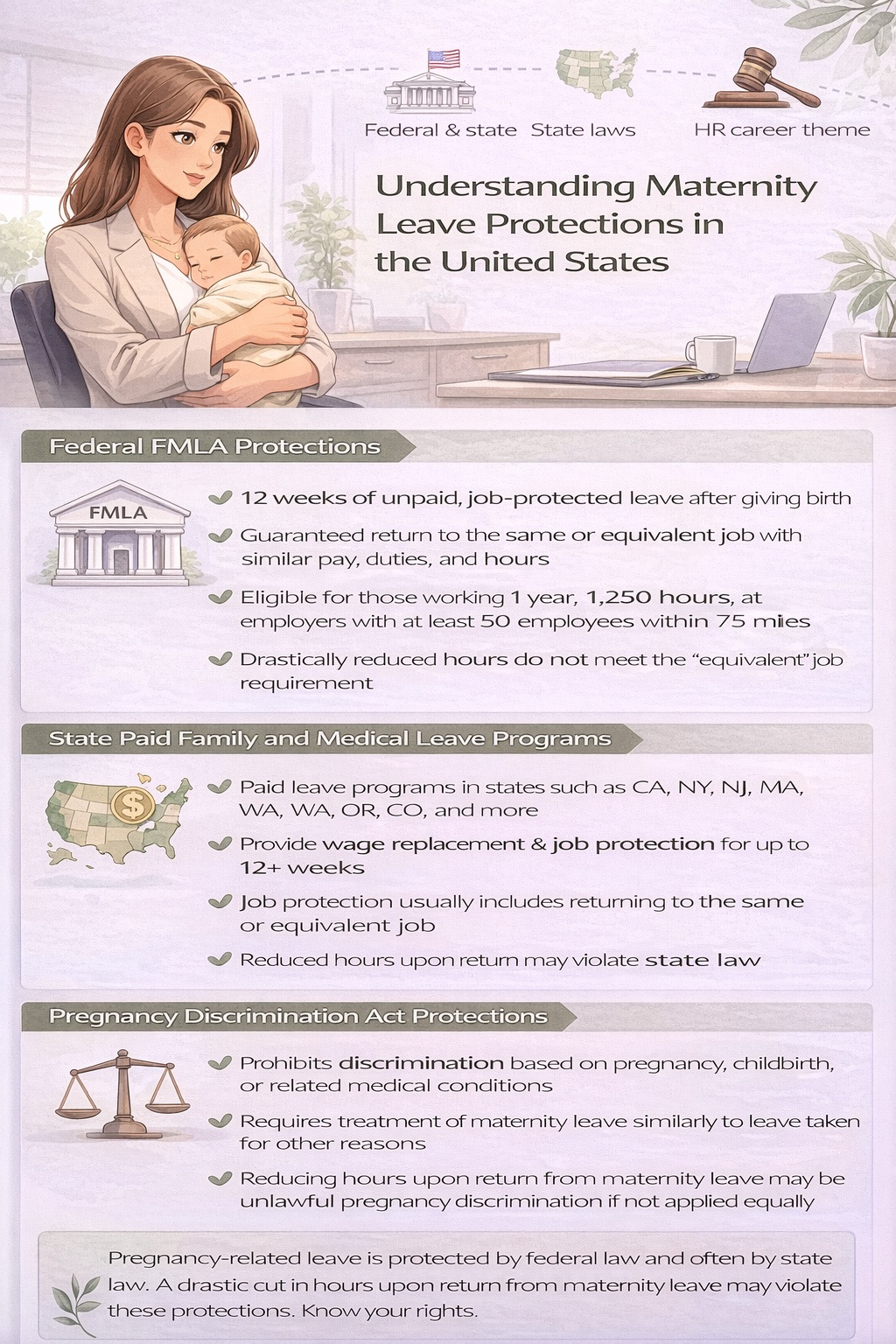
Federal FMLA Protections
The Family and Medical Leave Act, administered by the U.S. Department of Labor (dol.gov), provides the baseline federal protection for maternity leave in the United States. FMLA entitles eligible employees to take up to 12 weeks of unpaid, job-protected leave for the birth and care of a newborn child.
The job protection component of FMLA is critical and explicit. When you return from FMLA leave, your employer must restore you to your original job or to an equivalent job with equivalent pay, benefits, and other terms and conditions of employment. This isn’t a suggestion or a guideline—it’s a legal requirement.
“Equivalent” has specific meaning under FMLA. An equivalent position must involve the same or substantially similar duties, responsibilities, and working conditions. It must have the same or similar schedule and number of hours. It must provide equivalent pay and benefits. The position must require substantially equivalent skill, effort, responsibility, and authority.
Critically, being offered dramatically reduced hours—going from 30-40 hours per week to just 13 hours—does not meet the standard of restoration to the same or equivalent position. A reduction from full-time to very part-time status represents a fundamental change in the employment relationship that FMLA protections are designed to prevent.
However, FMLA eligibility requirements mean not all workers are covered. To be eligible for FMLA, you must have worked for your employer for at least 12 months, have worked at least 1,250 hours during the 12 months before your leave begins, and work at a location where the employer has at least 50 employees within 75 miles. Many workers, particularly those at smaller employers, fall outside FMLA coverage.
State Paid Family and Medical Leave Programs
Recognizing the limitations of federal FMLA, which provides unpaid leave only, several states have implemented their own paid family and medical leave programs. These state programs typically provide both wage replacement during leave and job protection upon return.
States with comprehensive paid family leave programs include California, New York, New Jersey, Rhode Island, Washington, Massachusetts, Connecticut, Oregon, Colorado, Delaware, Maryland, and the District of Columbia, with more states considering or implementing similar programs. Each program has different eligibility requirements, benefit levels, and duration limits, but they generally provide stronger protections than federal FMLA alone.
Massachusetts, for example, operates a Paid Family and Medical Leave program (mass.gov/pfml) that provides up to 12 weeks of paid leave for bonding with a new child. Importantly, this program includes job protection—your employer cannot terminate you or retaliate against you for taking leave, and you must be restored to your same or comparable position upon return.
The job protection under these state programs typically mirrors or exceeds FMLA standards. Being offered a dramatic reduction in hours upon return would likely violate these protections. According to the Massachusetts program specifically, employees have the right to return to the same position or an equivalent position with the same status, pay, employment benefits, length of service credit, and seniority.
If you live in a state with a paid family leave program and your employer is reducing your hours upon return, this likely constitutes a violation of state law, not just an unfortunate business decision. The state agency administering the program can investigate complaints and enforce compliance.
Pregnancy Discrimination Act Protections
Beyond leave-specific laws, the Pregnancy Discrimination Act, which amended Title VII of the Civil Rights Act, prohibits discrimination based on pregnancy, childbirth, or related medical conditions. This federal law, enforced by the Equal Employment Opportunity Commission (eeoc.gov), applies to employers with 15 or more employees.
Under the PDA, employers cannot discriminate against employees because of pregnancy or related conditions in any aspect of employment, including hiring, firing, pay, job assignments, promotions, layoffs, training, and benefits. Importantly, treating an employee less favorably because they took maternity leave can constitute pregnancy discrimination.
If your employer reduces your hours specifically because you took maternity leave or had a baby—even if they claim it’s due to “business needs” or changes in your child’s enrollment status—this could constitute unlawful pregnancy discrimination. The key question is whether the employer would have made the same decision for an employee who took leave for other reasons or who didn’t have children.
Understanding Maternity Leave Protections in Canada
Canadian workers generally enjoy stronger maternity and parental leave protections than their U.S. counterparts, though the specific details vary by province and territory.
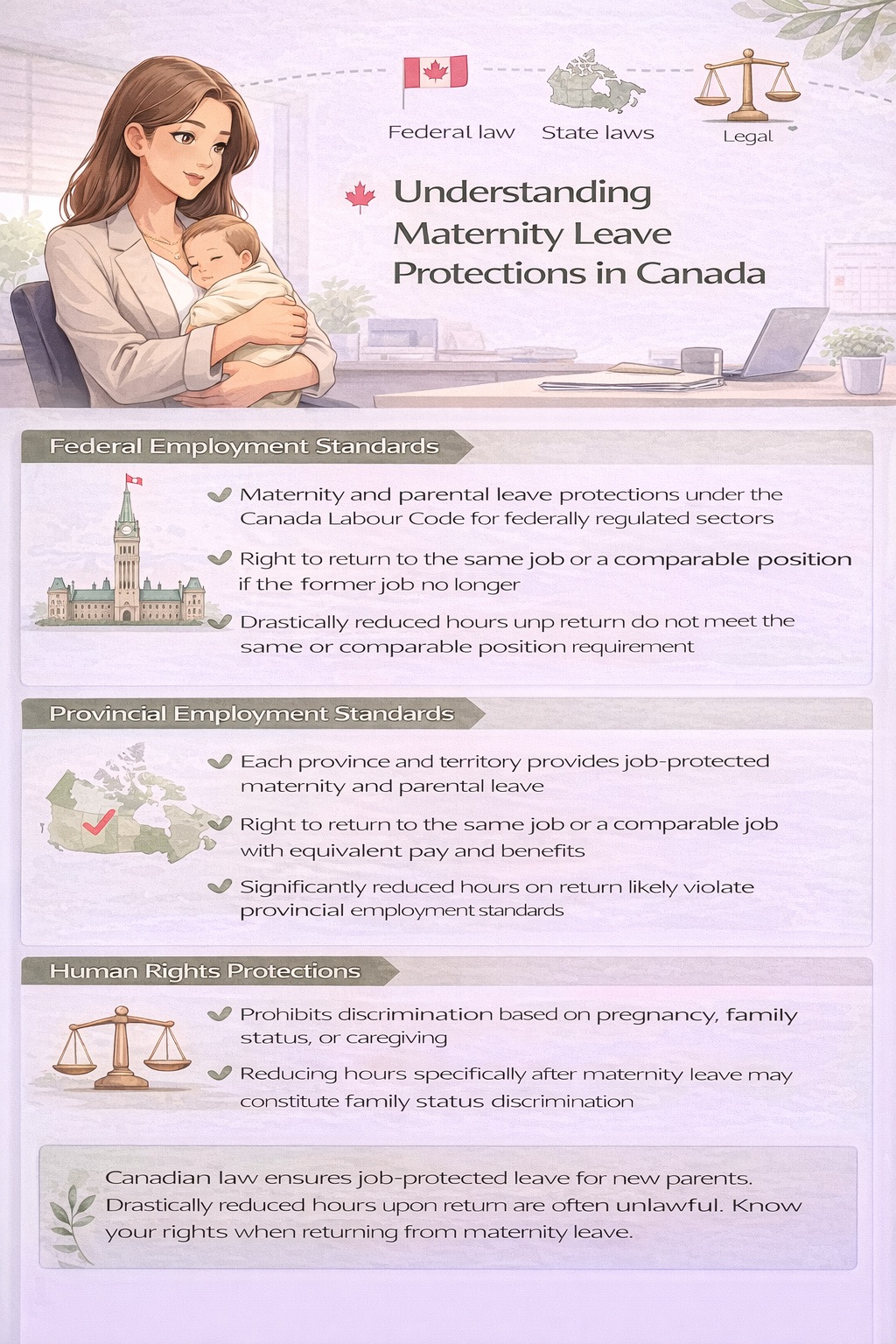
Federal Employment Standards
For federally regulated industries in Canada—including banking, telecommunications, interprovincial transportation, and federal public service—the Canada Labour Code sets employment standards including maternity and parental leave provisions. According to Employment and Social Development Canada (canada.ca), employees in federally regulated sectors are entitled to maternity leave and parental leave with job protection.
Under federal law, employees who take maternity or parental leave have the right to return to the same position they held before the leave. If that position no longer exists, the employer must provide a comparable position with at least the same wages and benefits.
Being offered significantly reduced hours upon return from maternity leave would not satisfy the requirement to return to the same or comparable position. A full-time position and a part-time position are not comparable in terms of wages, hours, or employment conditions.
Provincial Employment Standards
Most Canadian workers fall under provincial rather than federal jurisdiction, and each province has its own employment standards legislation governing maternity and parental leave. While specific provisions vary, all Canadian provinces and territories provide job-protected maternity and parental leave.
For example, Ontario’s Employment Standards Act (ontario.ca) provides for maternity leave of up to 17 weeks and parental leave of up to 61 or 63 weeks depending on circumstances. Employees who take pregnancy or parental leave are entitled to return to the position they held before the leave, or if that position no longer exists, to a comparable position.
British Columbia’s Employment Standards Act similarly protects employees taking maternity or parental leave, requiring employers to return employees to their former position or, if that’s not possible, to a comparable position with no less pay and benefits.
The consistency across Canadian provinces is that job protection means restoration to the same position or a truly comparable alternative—not a dramatic reduction in hours that fundamentally changes the nature of the employment relationship.
Human Rights Protections
Beyond employment standards legislation, Canadian human rights law at both federal and provincial levels prohibits discrimination based on family status, pregnancy, and related grounds. Treating an employee less favorably because they took maternity leave or have family caregiving responsibilities can constitute unlawful discrimination.
The Canadian Human Rights Commission (chrc-ccdp.gc.ca) has ruled in cases involving discrimination against employees with family responsibilities, establishing that employers cannot penalize workers for their parental and caregiving obligations. Reducing an employee’s hours specifically in connection with their return from maternity leave could constitute such discrimination.
Why Employers Reduce Hours After Maternity Leave
Understanding why employers reduce returning employees’ hours—even when doing so may violate legal protections—provides insight into how to address the situation effectively.
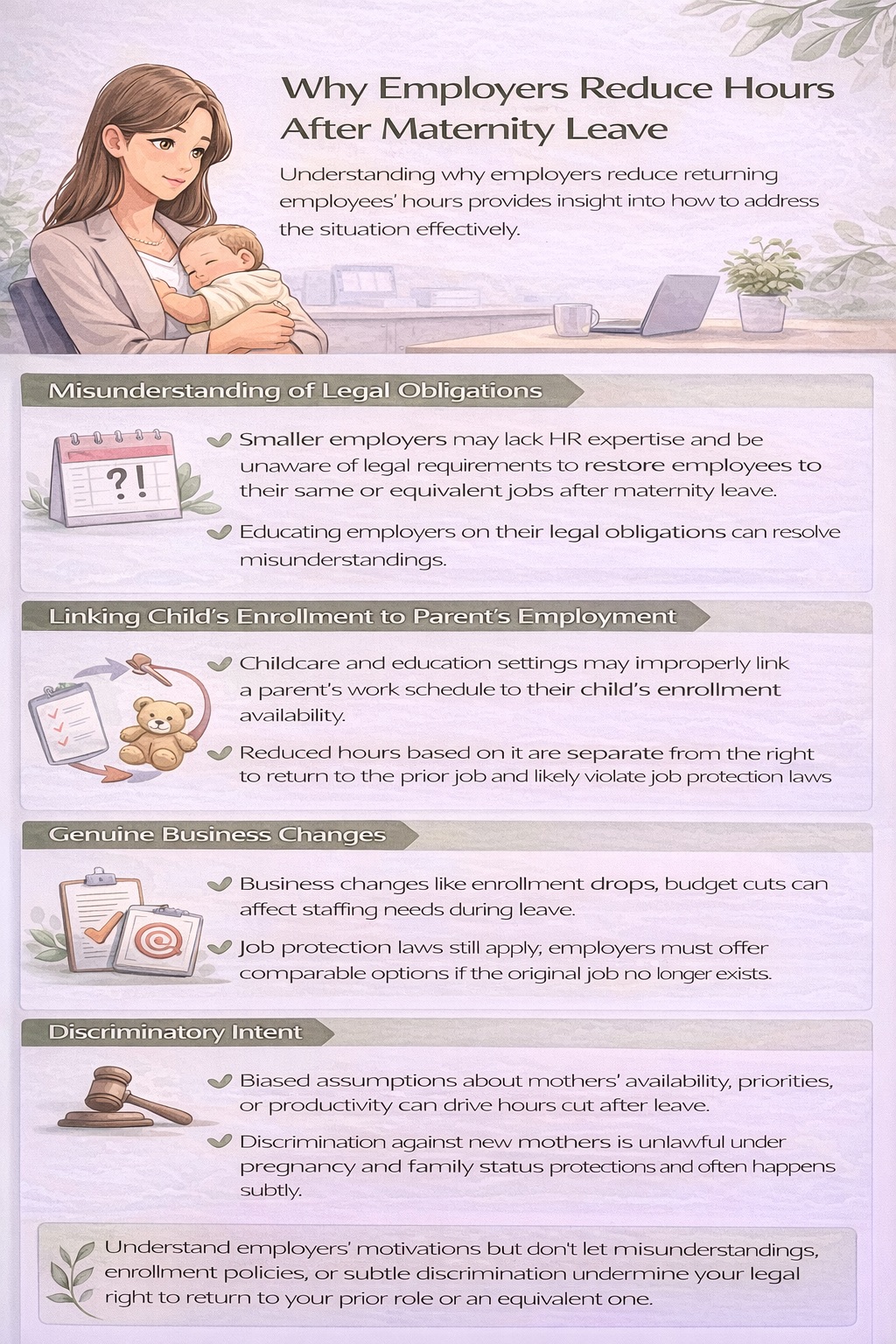
Misunderstanding of Legal Obligations
Some employers genuinely don’t understand their legal obligations regarding maternity leave job protection. Smaller employers in particular may lack sophisticated HR departments and operate on assumptions about their rights and obligations that don’t align with actual law.
An employer might believe that if business circumstances changed during an employee’s leave—enrollment dropped at a childcare center, a position was eliminated due to budget constraints, staffing was reorganized—they’re entitled to offer returning employees whatever positions are currently available, even if those positions bear little resemblance to the employee’s pre-leave role.
This misunderstanding doesn’t excuse violations, but it does suggest that clearly communicating the legal requirements and providing specific information about applicable protections might resolve the situation without escalation.
Linking Child’s Enrollment to Parent’s Employment
In childcare and education settings specifically, a particularly problematic practice involves linking a parent-employee’s work schedule to their child’s enrollment. When an employer tells a returning parent that their hours are reduced because there’s only a part-time enrollment spot available for their child, they’re essentially making the employee’s work contingency dependent on a separate transaction—their child’s enrollment.
This practice conflates two distinct relationships: the employment relationship between the worker and the employer, and the service relationship between the employer (as childcare provider) and the employee (as parent/client). These should be separate.
If the childcare center genuinely cannot provide full-time care for the employee’s child due to capacity constraints, that’s a separate issue from the employee’s right to return to their former position. The employee should have the option to secure alternative childcare and still return to full-time work. When employers indicate that hours depend on both the child’s enrollment AND “staffing needs,” they’re essentially saying the employee cannot return to their previous schedule under any circumstances—which likely violates job protection laws.
Genuine Business Changes
Sometimes genuine business changes during an employee’s leave do affect available positions. A childcare center might experience decreased enrollment leading to reduced staffing needs. A department might be reorganized. Budget cuts might eliminate positions.
However, even when genuine business changes occur, they don’t automatically override job protection requirements. The legal standard typically asks: would this change have affected the employee regardless of their leave? If the employee’s position was specifically targeted or if they’re being treated differently than they would have been had they not taken leave, the employer likely still violates job protection laws.
Additionally, if business changes affect multiple positions, the returning employee should have the same opportunity as other employees to bid on available positions, accept reassignments, or exercise seniority rights—not be automatically slotted into the least desirable remaining option simply because they were on leave.
Discriminatory Intent
Unfortunately, some employers reduce hours for returning mothers deliberately, either because they assume new mothers won’t want or can’t handle full-time work, because they’re concerned about ongoing childcare-related absences, or because they believe mothers should prioritize family over career. These biases, whether conscious or unconscious, lead to employment decisions that constitute unlawful pregnancy and family status discrimination.
At Decision Makers Hub, we’ve observed that discrimination against working parents, particularly mothers, remains persistent despite decades of legal protections. The discrimination often manifests subtly—not through explicit statements about a mother’s priorities or capabilities, but through actions like scheduling changes, reduced hours, loss of desirable assignments, or exclusion from advancement opportunities that systematically disadvantage parents who take leave.
How to Respond When Your Hours Are Reduced
If your employer offers you significantly reduced hours upon return from maternity leave, several steps can help you address the situation effectively while protecting your rights and interests.
Document Everything in Writing
Before taking any action, create comprehensive documentation of the situation. This documentation serves multiple purposes: it helps you organize your thoughts and position, creates a record if you later need to file a complaint or legal claim, and demonstrates that you took the situation seriously and attempted to resolve it professionally.
Document your original position before leave, including your typical work schedule, hours per week, job duties, and any written job descriptions or offer letters. Document any communications with your employer about your leave plans and expected return, particularly anything indicating you would return to your previous position and schedule. Document the employer’s current offer, including the specific hours, schedule, and any explanations they’ve provided for the reduction.
If the reduction relates to your child’s enrollment availability, document those communications separately, noting how the employer is linking your employment hours to your child’s enrollment.
Create a timeline of relevant events: when you notified your employer of your pregnancy, when your leave began, when you communicated about your return, when the employer first indicated reduced hours, and any subsequent discussions.
Keep all communications in writing when possible. If conversations occur verbally, send follow-up emails summarizing what was discussed: “I’m writing to confirm our conversation today in which you indicated that upon my return from maternity leave, I would be scheduled for approximately 13 hours per week rather than my previous 30-40 hours…”
Research Your Specific Legal Protections
Determine which laws apply to your situation. This depends on your location, your employer’s size, your length of employment, and other factors.
If you’re in the United States, check whether you’re covered by federal FMLA by reviewing the eligibility requirements. Check whether your state has a paid family leave program with its own job protections. Research whether state pregnancy discrimination laws or other employment protections apply.
If you’re in Canada, determine whether you’re federally or provincially regulated. Review the specific maternity and parental leave provisions in your applicable employment standards legislation. Consider whether human rights protections against family status discrimination might apply.
Government websites are the best sources for this information. The U.S. Department of Labor website provides detailed FMLA information. State labor department websites explain state-specific protections. In Canada, the federal government and each provincial government maintain employment standards information online.
If the legal language is confusing or you’re unsure which laws apply, consider consulting with an employment attorney who can provide specific guidance based on your circumstances.
Communicate Clearly With Your Employer in Writing
Once you understand your rights, communicate with your employer clearly and professionally about your expectation to return to your previous position and schedule.
A written communication might say something like:
“I am writing regarding my return from maternity leave. As we discussed, I am scheduled to return to work on [date]. I understand you have indicated that only 13 hours per week would be available to me upon my return, a significant reduction from my previous schedule of 30-40 hours per week.
Under [applicable law—FMLA, state paid family leave, provincial employment standards], I am entitled to return to my same position or an equivalent position with the same hours, pay, and working conditions as before my leave. A reduction from full-time to very part-time hours does not constitute restoration to the same or equivalent position.
I am prepared to return to work full-time on [date] and expect to be scheduled for the same hours I worked prior to my leave. Please confirm by [specific date] that my full-time schedule will be restored.”
This communication should be polite but firm. It clearly states your understanding of your legal rights, your expectation to return to your previous schedule, and requests confirmation. It creates a written record of your position.
If the employer’s explanation for reduced hours relates to your child’s enrollment, address that specifically: “I understand you’ve indicated that my work hours would be limited by the availability of enrollment for my child. My employment rights and my child’s enrollment are separate matters. I am entitled to return to my previous work schedule regardless of my child’s enrollment status. I can arrange alternative childcare if necessary.”
Request a Meeting to Discuss the Situation
After sending written communication, request a meeting with the appropriate person—likely your direct supervisor and/or the HR department if one exists. This meeting provides an opportunity to discuss the situation directly and potentially resolve it without further escalation.
Prepare for this meeting by reviewing your documentation, understanding your legal rights, and considering what outcomes you would find acceptable. Enter the meeting professionally and calmly, even if you feel angry or distressed about the situation.
In the meeting, reiterate your understanding that you’re entitled to return to your previous position and schedule. Ask the employer to explain the reasons for the reduction in hours. Listen carefully to their explanation—it may reveal whether this is a misunderstanding, a genuine business issue, or potentially discriminatory treatment.
If the employer cites business reasons for the reduction, ask specific questions: When was the decision made to reduce hours? Would your hours have been reduced if you hadn’t taken leave? Are other employees in similar positions working full-time? What would be required for you to return to full-time hours?
If the employer links the reduction to your child’s enrollment, clarify that you’re willing to arrange alternative childcare and ask whether full-time hours would be available if you did so. If they indicate that hours would still be limited due to “staffing needs,” ask for specific clarification about what staffing needs prevent your return to full-time work.
Take notes during this meeting, and send a follow-up email summarizing what was discussed and any commitments or next steps that were agreed upon.
Escalate Internally if Initial Response Is Inadequate
If direct communication with your supervisor doesn’t resolve the situation, escalate within the organization. If your employer has an HR department, HR director, or owner/executive leadership, bring the matter to their attention.
A formal written complaint to HR might state: “I am writing to formally report that I am being denied my right to return to my previous position following maternity leave. Despite my legal entitlement under [applicable law] to be restored to my same position or an equivalent position with equivalent hours and conditions, I have been offered only [reduced hours/schedule] upon my return. I have discussed this matter with [supervisor name] on [dates] but the issue remains unresolved. I am requesting that HR review this situation and ensure that my job protection rights are honored.”
Internal escalation sometimes resolves issues that supervisors either didn’t understand or didn’t take seriously. It also creates additional documentation that you attempted to resolve the matter through appropriate channels before pursuing external complaints or legal action.
File Complaints With Appropriate Government Agencies
If internal resolution attempts fail, filing complaints with government agencies that enforce employment and anti-discrimination laws provides another avenue for resolution.
In the United States, if you’re covered by FMLA, you can file a complaint with the U.S. Department of Labor’s Wage and Hour Division. The complaint must typically be filed within two years of the violation (three years if the violation was willful). The Department of Labor will investigate and can require the employer to comply with FMLA requirements and potentially pay damages.
If you believe you’ve experienced pregnancy discrimination, you can file a charge with the Equal Employment Opportunity Commission (EEOC). This must typically be done within 180 days of the discriminatory action, or 300 days if there’s also a state or local anti-discrimination law. The EEOC will investigate and may pursue action against the employer or issue you a “right to sue” letter allowing you to file a lawsuit.
Many states have their own agencies that enforce state labor laws and anti-discrimination laws, often providing stronger protections than federal law. State labor departments or human rights commissions can investigate violations of state family leave laws and discrimination prohibitions.
In Canada, if you’re under federal jurisdiction, you can file a complaint with the Labour Program at Employment and Social Development Canada. For provincial employees, contact your provincial employment standards office. Most provinces also have human rights commissions that investigate discrimination complaints.
Government agency processes typically cost nothing to initiate and don’t require hiring an attorney, though you may choose to have legal representation. The agencies have authority to investigate, require document production, and compel employer compliance.
Consider Legal Representation
Consulting with an employment attorney provides personalized legal advice based on your specific circumstances and can help you understand your options and the strength of your position.
Many employment attorneys offer free initial consultations where they’ll review your situation and advise you on whether you have viable legal claims and what remedies might be available. If you decide to pursue legal action, the attorney can represent you in negotiations with your employer, administrative proceedings, or litigation if necessary.
Some employment law claims, particularly discrimination claims, provide for recovery of attorney’s fees if you prevail, making legal representation more accessible even if you can’t afford hourly fees upfront. Many employment attorneys work on contingency (taking a percentage of any recovery) or modified fee arrangements.
Legal representation isn’t necessary for filing agency complaints or attempting internal resolution, but it can be valuable if the situation becomes complex, if your employer has legal representation, or if you’re considering a lawsuit.
Practical Considerations Beyond Legal Rights
While understanding and asserting your legal rights is crucial, you must also consider practical realities and personal circumstances when deciding how to respond to reduced hours.
Financial Impact and Immediate Needs
A reduction from 30-40 hours to 13 hours per week represents a dramatic income loss—likely 60-70% or more of your previous earnings. For most families, this creates immediate financial hardship that may be unsustainable even temporarily.
Consider your financial situation realistically. Can you afford the reduced hours while pursuing internal resolution or agency complaints—processes that might take weeks or months? Do you have savings to draw on, or would you need to find additional employment immediately?
If the financial impact is severe and immediate, you may need to pursue parallel paths: asserting your legal rights while simultaneously seeking alternative employment that provides the hours and income you need. This isn’t giving up on your rights—it’s being practical about supporting your family while seeking appropriate remedies for your employer’s violations.
Relationship With Employer
Consider the long-term viability of your employment relationship even if you successfully assert your rights and are restored to full-time hours. If your employer resisted restoring your hours and did so only under threat of legal action, will you be able to work effectively in that environment? Will you face retaliation or ongoing hostility?
While retaliation for asserting legal rights is itself illegal, it can be subtle and difficult to prove. Some employees find that even after winning a legal battle, the workplace becomes so uncomfortable that they eventually leave anyway.
This doesn’t mean you shouldn’t assert your rights—it means you should enter the process with realistic expectations about the potential impact on your ongoing employment relationship.
Alternative Employment Options
Depending on your field, location, and qualifications, alternative employment might be readily available or difficult to find. Research the job market in your area for positions similar to your current role. Would leaving this employer for another position be feasible? Would you likely find better conditions elsewhere, or are similar problems widespread in your industry?
For some workers, particularly those in fields with worker shortages or strong demand, the best solution might be finding new employment with an employer who respects legal obligations and values employees. For others, particularly in tight job markets or specialized fields, fighting for your current position might be the more viable option.
Emotional and Mental Health Considerations
The stress of dealing with employment problems while adjusting to life with a new baby can be overwhelming. Consider your emotional and mental health capacity to engage in what might be a lengthy, stressful process of asserting your rights through complaints, negotiations, or legal action.
There’s no shame in deciding that your mental health and family wellbeing take priority over fighting this battle, even if you’re legally in the right. Sometimes accepting an imperfect situation while you look for alternative employment is the healthiest choice for you and your family.
Conversely, some people find that asserting their rights and fighting for what they’re entitled to is empowering and important, both for their own situation and to prevent the employer from mistreating other employees similarly in the future.
Only you can determine the right balance for your circumstances. There’s no objectively correct answer—different people will reasonably make different choices based on their situations, values, and priorities.
Special Considerations for Different Employment Contexts
The specific context of your employment affects both your legal protections and practical options for addressing reduced hours.
Small Employers and FMLA Coverage Gaps
If you work for a small employer—fewer than 50 employees within 75 miles for FMLA purposes—you may not be covered by federal job protection regardless of how long you’ve worked there or how many hours you’ve logged. This coverage gap leaves many workers at smaller employers without the federal protections that larger employers must provide.
However, state laws often cover smaller employers than federal law. Many state family leave laws apply to employers with 15-50 employees, providing protections for workers who fall outside FMLA coverage. Additionally, pregnancy discrimination laws typically cover employers with 15 or more employees—a lower threshold than FMLA.
Even if you’re not covered by specific job protection laws, your employer’s actions might still violate general anti-discrimination laws or breach of contract principles if you had written employment agreements or employee handbook provisions promising specific terms.
Unionized Workplaces
If you work in a unionized environment, your union contract likely includes provisions about leaves of absence, job protection, and seniority rights. Review your collective bargaining agreement and contact your union representative immediately if your hours are reduced upon return from maternity leave.
Union contracts often provide stronger protections than statutory minimums, and your union has an obligation to represent you in grievances against the employer for contract violations. The union grievance process may be faster and more effective than pursuing individual complaints through government agencies.
Part-Time Employees and Variable Hour Workers
If you worked part-time before your leave, you’re entitled to return to a part-time position with equivalent hours—not further reduced hours. If your schedule varied before leave, determining what’s “equivalent” becomes more complex, but you should generally be restored to the same average hours and scheduling pattern you had before leave.
Don’t let an employer claim that because you were part-time before leave, they can offer you even fewer hours afterward. Job protection means restoration to the same or equivalent status, regardless of whether that status was full-time or part-time.
Professional and Exempt Employees
Most of the public discussion about maternity leave focuses on hourly or non-exempt workers, but exempt professionals also have job protection rights. If you’re a salaried professional—say, an HR system administrator, analyst, or manager—who took maternity leave, you’re entitled to return to your same position with the same responsibilities, authority, and compensation.
For exempt employees, “reduced hours” might manifest differently than for hourly workers—perhaps through reduced responsibilities, loss of supervisory authority, or reassignment to less significant projects rather than reduced scheduled hours. These changes can still violate job protection requirements if they result in a position that’s not equivalent to your pre-leave role.
Moving Forward: Options and Outcomes
Once you’ve considered your legal rights, practical circumstances, and personal priorities, you need to decide on a course of action and understand potential outcomes.
Successful Restoration to Previous Position
The ideal outcome is that your employer, whether through internal advocacy, government agency intervention, or legal pressure, restores you to your previous full-time position. This allows you to continue your career without interruption, maintain your income, and vindicate your legal rights.
If this occurs, it’s important to document the restoration clearly—get written confirmation of your schedule, hours, and position to ensure there’s no ambiguity. Monitor the situation carefully to ensure the employer doesn’t engage in subtle retaliation or create a hostile environment in response to your advocacy.
Negotiated Resolution
Sometimes the resolution involves negotiation and compromise. Perhaps the employer can’t immediately restore full-time hours but commits to doing so within a specific timeframe as business conditions change or staffing adjusts. Perhaps they offer a temporary alternative—different shifts, a different location, or a modified arrangement that provides more hours than initially offered even if not quite full-time.
Evaluate negotiated solutions carefully. A temporary reduction with a clear written plan for restoration to full-time within a defined period might be acceptable. Vague promises that you’ll get more hours “when possible” with no commitment or timeline probably isn’t.
If you accept a negotiated solution that’s less than full restoration to your previous position, get it in writing with specific terms: exactly what schedule you’re agreeing to, for how long, what will trigger restoration to full-time, and any other conditions. This protects you if the employer later fails to honor the agreement.
Accepting Reduced Hours While Seeking Alternative Employment
You may decide that fighting for your current position isn’t worth the time, stress, or uncertainty, and instead accept the reduced hours temporarily while seeking new employment. This is a pragmatic choice that prioritizes moving forward rather than seeking vindication for past wrongs.
If you choose this path, don’t necessarily abandon your legal rights. You may still be able to pursue claims for damages resulting from your employer’s violation—lost wages, emotional distress, attorney’s fees—even after you’ve moved to new employment. Consult with an employment attorney about whether pursuing such claims makes sense in your situation.
Refusing Reduced Hours and Pursuing Legal Remedies
If your employer refuses to restore your hours despite your legal entitlement to the same or equivalent position, you may need to refuse the inadequate offer and pursue legal remedies through agency complaints or litigation.
This path involves risk. If you refuse the employer’s offer of reduced hours, you may be considered to have resigned or abandoned your position, at least from the employer’s perspective. However, if the offered position genuinely doesn’t meet the legal standard of “same or equivalent,” you may be entitled to refuse it and still pursue remedies.
This is complex legal territory where attorney advice is particularly valuable. The strength of your position, the specific laws that apply, and the facts of your situation all affect whether refusing inadequate restoration is strategically wise.
Preventing Future Problems
Whether you successfully resolve your current situation or move to new employment, understanding how to protect yourself regarding maternity leave and job protection in the future helps prevent similar problems.
Understand Your Rights Before Taking Leave
Research applicable job protection laws before you take maternity leave, not after you’ve encountered problems. Know whether you’re covered by FMLA, state family leave laws, or other protections. Understand what rights you have and what your employer’s obligations are.
This knowledge empowers you to have informed discussions with your employer before leave about expectations for your return. It also helps you recognize violations immediately if they occur rather than only after you’ve accepted an inadequate arrangement.
Document Everything From the Beginning
Start documentation early in your pregnancy and continue throughout your leave and return. Keep copies of all communications with your employer about your pregnancy, leave plans, and return arrangements. Document any promises or representations the employer makes about your position upon return.
This documentation becomes crucial if disputes arise. Employers often have short memories about what was promised or agreed to, and written records protect you.
Communicate Clearly About Return Plans
Well before your return date, communicate clearly with your employer about when you’ll return and your expectations for your schedule and responsibilities. Don’t assume the employer remembers your previous schedule or will automatically restore you to your former position—make your expectations explicit and get confirmation in writing.
If you encounter resistance or concerning responses, you’ll have time to address issues before your leave ends rather than being surprised at the last minute.
Know Where to Get Help
Identify resources before you need them. Know which government agency handles employment law complaints in your jurisdiction. Identify employment attorneys in your area who handle maternity leave and discrimination cases. Find out if your employer has internal complaint procedures or if you’re represented by a union with grievance processes.
Having this information readily available means you can act quickly if problems arise rather than scrambling to figure out where to turn for help while dealing with the stress of a newborn and employment uncertainty.
The Bigger Picture: Systemic Issues and Advocacy
Individual workers dealing with reduced hours after maternity leave are experiencing symptoms of broader systemic problems in how workplaces treat working parents, particularly mothers.
The Motherhood Penalty
Research consistently documents what sociologists call the “motherhood penalty”—the career and earnings disadvantages that women experience after having children. Mothers face discrimination in hiring, promotion, and compensation compared to childless women and to men regardless of parental status.
The reduction of hours for returning mothers represents one manifestation of this penalty. Employers assume mothers will be less committed, less available, or less capable after having children, and make employment decisions based on these stereotypes rather than individual performance and stated preferences.
Understanding that your individual experience is part of a larger pattern doesn’t make it less frustrating, but it does contextualize what might otherwise feel like personal failure or bad luck.
Workplace Culture Change
Addressing these issues requires culture change beyond individual legal compliance. Workplaces need to move from viewing maternity leave as a disruption to be minimized toward viewing it as a normal part of employment that’s accommodated seamlessly.
This involves leadership commitment to equal treatment of working parents, manager training on job protection obligations and unconscious bias, policies and practices that normalize parental leave for all genders, and accountability for supervisors who don’t support returning employees appropriately.
Policy Advocacy
Systemic change also requires policy improvements. The United States remains the only developed nation without universal paid parental leave. Expanding paid leave access and strengthening job protection enforcement would help countless workers who currently face impossible choices between financial security and caring for their children.
Supporting policy advocacy organizations working on these issues, contacting elected representatives about the importance of family leave protections, and speaking publicly about your experiences all contribute to building political will for policy improvements.
Asserting Your Rights Matters
Discovering that your employer won’t restore your full-time hours after maternity leave feels like a betrayal, especially when you’ve dedicated years to your job and assumed your position would be waiting when you returned. The stress of fighting for your rights while adjusting to life with a new baby can feel overwhelming.
But asserting your rights matters—not just for you personally, but for creating workplace environments where having children doesn’t derail careers. Every time a worker successfully advocates for proper job restoration after maternity leave, it becomes slightly harder for employers to assume they can violate these protections with impunity.
You deserve to return to the position you left, with the hours and responsibilities you had before your leave. This isn’t special treatment—it’s what the law requires. Whether you ultimately stay with your current employer or move on to better opportunities, standing up for your rights validates your worth as an employee and as a person balancing the vital roles of worker and parent.
At Decision Makers Hub, we believe that workplaces function best when they honor both legal obligations and basic fairness. Employees shouldn’t have to choose between having children and maintaining their careers. Employers who create supportive environments for working parents benefit from loyal, engaged, productive employees. And society benefits when workers can contribute their talents and skills while also raising the next generation.
Your specific situation will require decisions based on your unique circumstances, values, and priorities. But whatever path you choose, know that expecting to return to your full-time position after maternity leave isn’t unreasonable—it’s your legal right. And fighting for that right, in whatever form makes sense for you, is worthwhile.